Avoid your inquiry is delay response, please enter your WhatsApp/Skype along with the message, so we can contact you at the very first time.
We will reply you within 24 hours. If for urgent case, please add WhatsApp/WeChat:
Warning: Undefined variable $public in /www/wwwroot/lvfertilizer.com/wp-content/themes/hyhadmin/header.php on line 350
Warning: Trying to access array offset on value of type null in /www/wwwroot/lvfertilizer.com/wp-content/themes/hyhadmin/header.php on line 350
,. Or call
Warning: Undefined variable $public in /www/wwwroot/lvfertilizer.com/wp-content/themes/hyhadmin/header.php on line 350
Warning: Trying to access array offset on value of type null in /www/wwwroot/lvfertilizer.com/wp-content/themes/hyhadmin/header.php on line 350
directly.
Plants look fine… until they don’t. Leaves pale. Growth slows. Flowers drop. The problem is often nutrients. The stress gets worse fast, and you can lose yield and quality. The fix is simple: understand N-P-K and match the right fertilizer to the crop and soil.
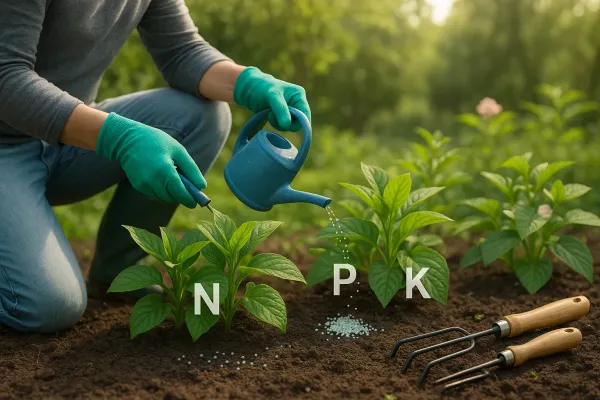
NPK fertilizer helps plants by supplying nitrogen for green growth, phosphorus for roots and flowering, and potassium for water balance and stress resistance. The three numbers on a bag show how much of each nutrient is inside, so you can choose the right mix for your crop stage and soil test.
NPK stands for nitrogen, phosphorus, and potassium. You will also see it written as n-p-k on a fertilizer label or a product brochure. These three are called “primary nutrients” because plants need to grow with them in much higher amounts than most other elements.
Here’s how I explain it to new importers and farm clients: think of the plant as a small factory. It needs materials (nutrient supply), a power system (energy transfer), and a water and nutrient movement system. When any one of the big three is missing, the whole line slows down—plant vigor drops, plant health weakens, and the overall plant can’t hit its potential.
A quick reality check: global agricultural use of inorganic fertilizers has grown over time, and nitrogen, phosphorus, and potassium use are tracked separately because they matter so much for food and fiber production.
What does NPK stand for
Let’s answer the question buyers ask most often: what do the numbers on fertilizer mean? The numbers on fertilizer are a set of three numbers—usually three numbers separated by dashes—that show the percentage by weight of nitrogen, phosphorus (reported as P₂O₅), and potassium (reported as K₂O). (
A short quote I like because it’s plain and accurate: “The three numbers… represent the percentage, by weight, of N, P₂O₅, and K₂O.”
So a 20-20-20 fertilizer (or 20-20-20: 1 time in your specs) means the fertilizer contains 20 percent nitrogen, 20 percent phosphate (P₂O₅), and 20 percent potash (K₂O). ) This is why many people call it a complete fertilizer—it includes all three primary nutrients. An incomplete fertilizer might supply only one or two.
| Example label | What it means (by weight) | Why it matters for procurement |
| 10-20-10 fertilizer | 10% N, 20% P₂O₅, 10% K₂O | Often used when root growth and early establishment matter most |
| 20-20-20 | Balanced supply of all three | Popular “general purpose” option in many programs |
| 5-10-5 | Lower analysis, often used in blends | Good for gentle feeding or when soil already has nutrients |
And yes, the math on a bag of fertilizer is real: a 5 lb bag of 10-5-5 fertilizer contains 0.5 lbs N, 0.25 lb P₂O₅, 0.25 lb K₂O. (That’s not a recommendation—just how labels work.)
One more nuance that many teams miss: a product that “looks balanced” can behave like a high-nitrogen feed depending on how phosphorus and potassium are expressed on local labels. The RHS explains how “7:7:7” can convert to different actual ratios in elemental terms.
If a crop manager says, “My plants turn pale,” I first think about nitrogen. Nitrogen is strongly linked to leaf growth, chlorophyll, and the look of healthy green growth. When nitrogen is low, plants often lose color and slow down.
In practical field language: nitrogen supports “top growth.” That matters for leafy vegetables, young seedlings, and any phase where foliage growth is more important than fruit growth. But fertilizers high in nitrogen can also push too much soft growth if timing is wrong—so you always match the program to the crop stage.
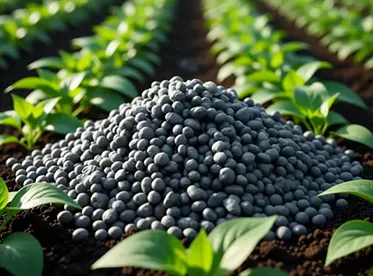
From a manufacturing side, this is why buyers ask us for different NPK grades and a steady supply: when your distributor network is large, you need consistent granule strength, uniform size, and stable nitrogen content so farmer results don’t swing season to season.
Phosphorus is the quiet builder. It supports root growth, energy transfer inside the plant, and strong early development. It is also tied to flowering plants and early flower and fruit set.
When phosphorus is short, plants may look stunted, root systems stay small, and flowering can be delayed. This is why programs often focus on phosphorus for transplanting, establishment, and early-season stress. In many crops, phosphorus and potassium get more attention once a plant shifts from leaf production to reproductive growth.
Also remember: phosphorus behavior depends on soil conditions. That is one reason soil test results are so valuable (more on that soon). You do not want to keep adding phosphorus when the soil already tests high—buyers hate waste, and agronomists hate runoff risk.
Potassium is often called the “quality nutrient.” It supports the movement of water and nutrients, helps regulate water balance, and improves tolerance to stress like heat or drought. Potassium helps plants stay strong when conditions are not perfect. (
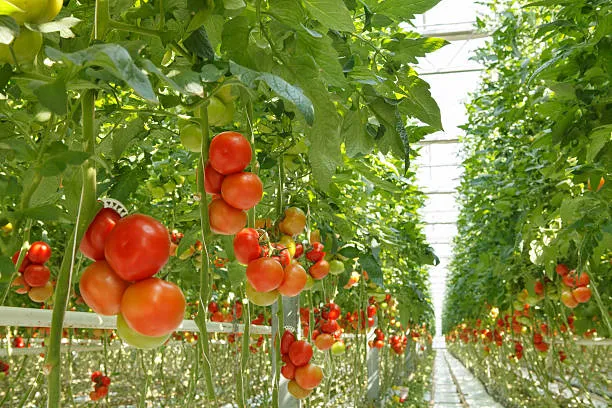
In real programs, you will hear “potash” and “potassium in the fertilizer” used almost like a shorthand for crop strength: better firmness, better transport quality, and improved overall plant health. It also supports flowering and fruit-bearing plants, because stable water management helps fill and finish fruit.
When customers ask me, “Do I need more potassium?” my honest answer is: maybe—but only when the crop stage and soil levels say so. That’s why different npk options exist.
This is where many teams make money—or lose it. The goal is not “the best fertilizer” in general. The goal is the best fertilizer for this crop, this stage, this soil, and this method.
Here’s a simple decision guide I share with distributor partners:
| Crop stage | What you want to support | A common direction (not a rule) |
| Early growth | Leaves and stems | Fertilizer with higher nitrogen |
| Rooting | Growth of roots | Higher P compared to N |
| Flowering/fruiting | Flower + fruit growth | More K relative to N |
Now, procurement reality: you might supply both granular fertilizers and water-soluble products across many channels. So I like to frame selection by use method too:
If you want product examples to compare in your own catalog planning, you can look at pages like NPK 10-10-10 compound fertilizer, NPK 15-15-15 fertilizer, and water soluble fertilizer 20 20 20 on our site.
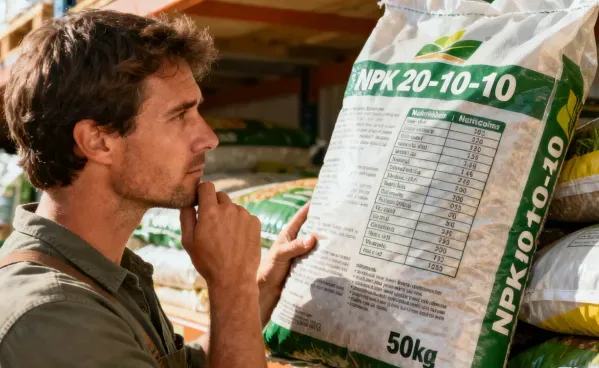
How to choose the right fertilizer
If I could enforce one rule across every market we serve, it would be this: run a soil test before you lock a big fertilizer purchase.
Why? Because a soil test tells you what the soil already has—and what it does not. Many extension programs recommend fertilizing based on soil test results and plant needs, not habit or guesswork.
A soil test also prevents common waste:
From a supply standpoint, soil-test-driven procurement helps importers too. It lets you plan a cleaner product mix: fewer slow-moving SKUs, better forecasting, and a tighter seasonal shipping plan.
People often ask me if organic fertilizers are “better.” I prefer a more useful question: what changes in performance and planning?
Here’s the practical procurement point: the n-p-k ratio of organic fertilizers is typically lower, and the nutrient release depends on biology, moisture, and temperature. That means organic programs often require tighter management and patience, while synthetic programs require tighter control to avoid over-application.
Many real-world operations use both: organic matter inputs for soil structure and a targeted NPK plan for consistent production. The smartest buyers build portfolios that match local farming styles rather than pushing one ideology.
Let’s talk about applying fertilizer in a way that protects crops and your reputation as a supplier.
Fast availability | Water-soluble fertilizer
Medium | Standard granular blends
Slow & steady | Slow-release fertilizers
One commercial farm group we supplied through an importer had uneven color and weak plant vigor early in the season. Instead of switching brands blindly, they ran a soil test and adjusted their fertilizer numbers to fit the gap. The result was more uniform growth, better root growth, and smoother flowering later. No magic—just matching nutrients to reality.
If your team serves multiple channels, it helps to keep both compound and soluble lines available. For example, many buyers review npk compound fertilizer and water soluble npk fertilizer ranges side by side, then build a seasonal plan around them.
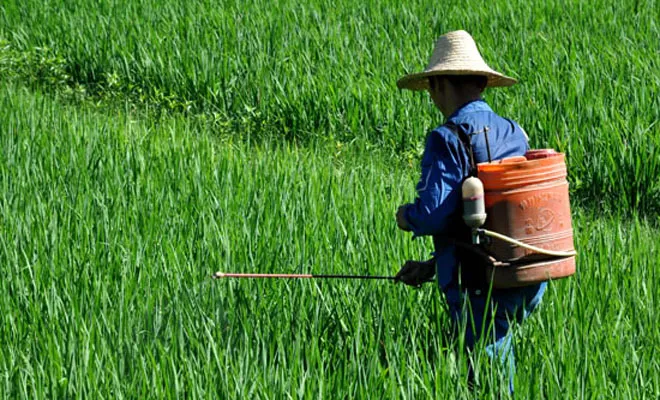
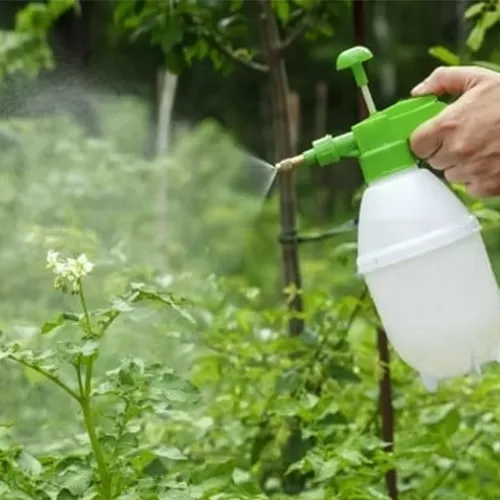
Applying fertilizer safely in farms
NPK stands for nitrogen, phosphorus, and potassium—the three primary nutrients most plants need to grow well.
The idea is the same, but labeling rules can differ. Many labels express phosphorus as P₂O₅ and potassium as K₂O, so always read every fertilizer label carefully when importing.
No. 20-20-20 can be a flexible “general” option, but the best choice depends on the type of plant, crop stage, and soil test.
Sometimes, but it’s not ideal. Vegetables may need different timing than flowering plants, and lawn fertilizers often prioritize nitrogen for consistent foliage growth. Your soil test and goal should guide the selection.
Start with your crop map, soil conditions, and irrigation methods. Then plan a portfolio: balanced grades, higher-nitrogen options, higher P or K options, plus water-soluble products for fertigation. If you need OEM support, we can help design labels, packaging, and stable supply lots as a China-based manufacturer and exporter. (See our About Us page for factory and export details.)
Send your target grade (or desired npk ratio), form (granular fertilizers or soluble), packing needs, destination port, and any compliance or registration requirements. If you’re unsure, share crop + soil test summary and we’ll suggest suitable options.