Avoid your inquiry is delay response, please enter your WhatsApp/Skype along with the message, so we can contact you at the very first time.
We will reply you within 24 hours. If for urgent case, please add WhatsApp/WeChat: ,. Or call directly.
Summer should be a season of strong growth, flowers, and fruit. Yet heat, dry soil, and the wrong fertilizer can quickly stress plants. Applying too much NPK during hot weather may make the problem worse. The solution is simple: match the NPK ratio, application rate, soil moisture, and timing to what the plant actually needs.
Yes, you can use NPK fertilizer in summer when plants are actively growing and have enough water. Avoid fertilizing plants suffering from extreme heat or drought. Choose the NPK ratio according to the crop and growth stage, apply moderate amounts, and water the soil properly. Flowering and fruiting plants often benefit from more phosphorus and potassium, while leafy plants usually need more nitrogen.
As a leading manufacturer and exporter of high-quality fertilizer products in China, we work with agricultural distributors, commercial farms, cooperatives, fertilizer brands, and agricultural projects in different climates. One lesson comes up again and again: there is no single “summer fertilizer” that is best for every plant.
The right choice depends on the plant, the soil, the weather, and the stages of growth.

Can I Use NPK Fertilizer in Summer? Best NPK Ratios for Flowers, Gardens, and Plant Growth
Yes. In many cases, summer is an important part of the growing season, so garden plants still require nitrogen, phosphorus, potassium, and other essential plant nutrients.
The problem is not summer itself. The problem is plant stress.
When temperatures become extremely high and the soil becomes very dry, roots cannot absorb water and nutrient elements efficiently. Adding a strong fertiliser at this time can raise soluble salt levels around the roots. Instead of helping plants grow, this may increase stress.
Oregon State University Extension recommends waiting to fertilize during periods of intense heat because encouraging new growth is not ideal when plants are already heat-stressed. Ohio State Extension gives similar advice and recommends avoiding fertilizer when plants are dormant or suffering from heat and drought.
A simple rule works well:
Feed an actively growing plant. Do not try to force a severely stressed plant to grow.
If your garden is well irrigated, the plant is growing normally, and temperatures are within its normal range, a carefully selected NPK fertiliser can continue to support healthy growth throughout summer.
The three numbers on an NPK fertilizer package represent the percentages of nitrogen, phosphorus, and potassium.
For example:
| NPK Ratio | Nitrogen | Phosphorus | Potassium | Typical Focus |
|---|---|---|---|---|
| 20-20-20 | 20% | 20% | 20% | Balanced plant growth |
| 30-5-5 | High | Low | Low | Leafy growth and foliage |
| 10-30-20 | Moderate | High | High | Root, flower and bloom support |
| 15-15-30 | Moderate | Moderate | High | Flowering and fruiting |
| 12-12-36 | Moderate | Moderate | Very high | Fruit development and quality |
The first number is nitrogen. Nitrogen supports green growth, leaves, stems, proteins, and chlorophyll formation.
The second number represents phosphorus. Phosphorus is closely connected with root development, energy movement, flowering, and fruit formation.
The third represents potassium. Potassium supports water regulation, plant strength, crop quality, and resistance to environmental stress.
Wisconsin Extension notes that phosphorus plays an important role in root development, flowering, and fruiting, while potassium helps plants tolerate temperature extremes, drought, and disease stress.
That is why understanding the NPK ratio matters more than simply choosing the bag with the largest numbers.
For a deeper comparison of commercial formulations, buyers can explore our custom NPK compound fertilizer range.
There is no universal best NPK formula.
The best NPK depends on the plant, its growth rate, soil nutrients, temperature, irrigation conditions, and nutrient needs at that particular time of year.
For general growing plants, a balanced fertilizer such as 15-15-15, 19-19-19, or 20-20-20 may provide an even supply of the three major nutrients.
For example, a balanced NPK 19-19-19 water-soluble fertilizer can support foliage, roots, and reproductive development when plants need broad nutrition instead of one dominant nutrient.
But do not assume that balanced always means better.
A plant that already has enough phosphorus in the soil may not benefit from additional phosphorus. Likewise, high nitrogen may create too much foliage when your goal is flower and fruit production.
This is where a soil test becomes valuable.
A soil test can tell the gardener or commercial grower whether the soil already contains enough nutrients and which element is limiting plant growth. Oregon State University Extension recommends starting nutrient planning with soil testing rather than adding more fertiliser automatically.
For large farms, we also recommend combining soil results with crop type, yield target, irrigation method, and local climate before selecting a formula.

Can I Use NPK Fertilizer in Summer? Best NPK Ratios for Flowers, Gardens, and Plant Growth
Many gardeners believe that every flower needs a very high-phosphorus fertiliser. The real picture is more balanced.
Flowering plants require all three major nutrients.
Nitrogen keeps leaves and stems healthy. Phosphorus contributes to root development and reproductive processes. Potassium supports plant strength, water regulation, flower quality, and stress tolerance.
During the early growing stage, a balanced fertilizer can support the whole plant. When the plant moves toward bloom and fruit production, growers may gradually reduce excessive nitrogen and increase the relative share of phosphorus and potassium when soil and crop conditions justify it.
For example:
Our NPK 15-15-30 water-soluble fertilizer is one example of a formula designed around higher potassium demand during later plant development.
The key point is not to chase bloom with more fertiliser than the plant needs.
Excess nitrogen can produce lush leafy growth at the expense of reproductive development.
Texas A&M Extension also notes that while nitrogen is needed throughout the plant, phosphorus helps form roots, flowers, and fruit, while too much nitrogen can damage plants.
Summer fertilizing requires more care than simply spreading granules around plants.
Start with the soil.
If the soil is extremely dry, water first. Dry roots cannot use nutrients effectively, and concentrated fertiliser salts may increase root damage.
Ohio State Extension recommends watering the soil before applying fertilizer and watering again afterward during hot weather.
A simple summer routine is:
For commercial production, splitting nutrient applications can often provide better control than one large dose.
Virginia Tech explains that nitrogen is more mobile than phosphorus and potassium and should be applied reasonably close to the time when crops can use it.
Small, well-timed applications often make more sense than one heavy summer application.
Both granular fertiliser and liquid feeds can work in summer. They simply work differently.
A granular fertilizer is applied to the soil and gradually dissolves as it receives water.
Its benefits may include:
Granular products can be useful for garden beds, field crops, perennial plants, trees, and broad-acre agriculture.
Water-soluble or soluble plant food dissolves in water before application.
It can be delivered through:
This allows growers to feed plants in smaller, more controlled doses.
If you are comparing the two formats, our guide to liquid, water-soluble, and granular fertilizer differences explains how nutrient release changes between application methods.
Containers deserve special attention.
Plants in containers have a much smaller root environment and receive frequent irrigation. Nutrients can wash out quickly. Iowa State University Extension explains that container-growing media generally holds fewer nutrients than field soil, which is why low-dose water-soluble feeding or controlled-release fertiliser is commonly used.
However, high summer temperatures can also make some controlled-release granules release nutrient faster.
So again: often and how much you feed depends on the plant and growing system.
Can I Use NPK Fertilizer in Summer? Best NPK Ratios for Flowers, Gardens, and Plant Growth
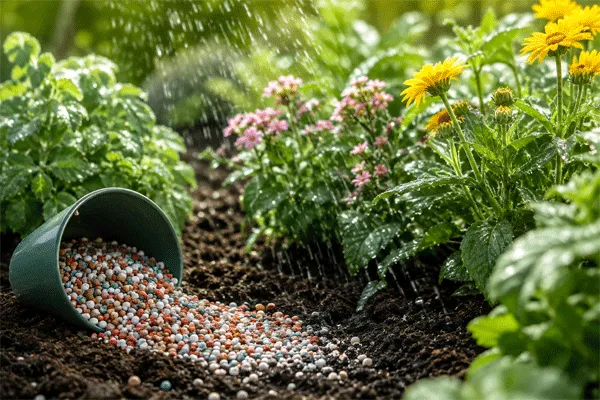
Water is not just something you add after fertilizing. It is part of the nutrient delivery process.
Roots absorb most mineral nutrients from the soil solution. If the soil is too dry, even a nutrient-rich fertiliser cannot perform as expected.
Too much water creates a different problem.
Heavy irrigation or summer storms may move mobile nutrients below the root zone. Nitrogen is especially vulnerable, while potassium can also leach under certain soil conditions.
This creates three possible situations:
Too little water: nutrients remain unavailable and salts become concentrated.
Correct water: nutrients dissolve and move into the active root zone.
Too much water: some nutrients move away before plants absorb them.
For drip-irrigated commercial farms, fertigation can provide much tighter control because fertilizer and irrigation are managed together. Buyers planning these systems can review our water-soluble fertilizer guide for drip irrigation and fertigation.
The goal is not simply to feed your plants. The goal is to put the right nutrient in the root zone while roots can actually use it.
Absolutely.
Different plants have different nutrient needs. Even the same plant may need a different formula at different stages of growth.
Consider this simplified example:
| Plant Type / Stage | Main Need | Possible NPK Direction |
|---|---|---|
| Young plants | Gentle establishment | Mild, balanced nutrition |
| Leafy vegetables | Foliage and green growth | Higher nitrogen |
| Flowering ornamentals | Bloom and plant strength | Moderate N, higher P/K when needed |
| Fruiting vegetables | Flowering and fruiting | Higher potassium |
| Fruit expansion | Size, quality, stress resistance | High potassium |
| Root crops | Root development | Controlled N, adequate P and K |
| Plants in containers | Frequent nutrient replacement | Balanced soluble feeds |
| Heat-stressed plants | Recovery first | Delay normal feeding |
Plants like vegetables can change their nutrient demand quickly.
A tomato plant in early vegetative growth may use more nitrogen than it does during heavy fruit production. If you continue using a high nitrogen fertilizer late into the season, you may get impressive leaves but disappointing fruit production.
UC Agriculture and Natural Resources notes that excess nitrogen in tomatoes can increase vine growth beyond crop demand.
The same principle applies to many garden plants.
Feed the plant according to what it is doing now, not only according to its name.
Yes, especially if you apply too much fertiliser to dry soil.
Fertilizer contains soluble mineral salts. At the correct concentration, these elements provide essential plant nutrients. At excessive concentration, they can interfere with the roots’ ability to take up water.
This is commonly called fertilizer burn.
Signs may include:
Virginia Cooperative Extension explains that when soil moisture is limited, concentrated soluble salts can make water uptake more difficult and may damage root tips.
To reduce the risk:
A hungry plant needs enough nutrients.
It does not need unlimited nutrients.
NPK fertiliser and soil improvement are not competing ideas.
A productive soil needs both available mineral nutrients and good physical conditions.
Compost and organic matter can improve soil structure, microbial activity, aeration, and water-holding capacity. In some soils, these improvements help the root system use fertiliser more efficiently.
Organic fertilizers release nutrient elements differently from conventional soluble products. Their performance can depend more heavily on biological activity, temperature, and moisture.
This means a sensible garden program may combine:
Plants require more than N, P, and K. Calcium, sulfur, magnesium, iron, zinc, manganese, boron, copper, and other elements also matter.
But adding every element “just in case” is poor nutrient management.
Feed your soil where soil improvement is needed. Feed the plant where a specific nutrient requirement exists.
That distinction helps reduce waste.
The answer varies widely.
A water-soluble fertiliser may become available very quickly, while a slow-release granular fertilizer may supply nutrients gradually for weeks or months.
Nitrogen generally changes and moves faster in soil. Phosphorus often reacts with soil minerals and moves much less. Potassium behavior sits somewhere between the two and depends strongly on soil texture and mineral composition.
That means the fertilizer you applied three weeks ago has not necessarily “disappeared.”
Before automatically adding another dose, consider:
Our guide explaining how long NPK fertilizer lasts in soil covers these differences in greater detail.
This is especially important for commercial growers and agricultural distributors designing seasonal programs. Over-fertilizing not only increases cost. It can also create salt stress, poor nutrient balance, leaching, and unnecessary environmental losses.
For a home gardener, buying one bag may be enough.
For agricultural distributors, importers, commercial farms, cooperatives, government projects, and private-label fertilizer brands, the decision is much bigger.
A useful fertilizer program starts with five questions:
This is also why we do not believe every market should receive exactly the same NPK ratio.
As a China-based fertilizer manufacturer and exporter, we can develop compound and water-soluble formulations based on regional soil conditions, crop demand, and buyer requirements. LvFeng’s manufacturing operations include multiple fertilizer production lines and support customized formulations for international customers.
For distributors and fertilizer brand owners, customization can include:
This matters because a fertilizer brand should solve a real farming problem.
A high-nitrogen leafy vegetable product should not be positioned exactly like a high-potassium fruit-development product.
The more accurately the product matches specific plant needs, the easier it becomes for farmers to understand its value and use it correctly.
Yes. You can fertilize a garden during summer if the plants are actively growing, the soil contains enough moisture, and the plants are not under severe heat or drought stress. Use the right fertilizer at the recommended rate.
Usually, it is better to wait. Plants under severe heat stress are focused on survival, not rapid plant growth. Water and heat protection are more important until conditions improve.
There is no single best NPK ratio for every flower. A balanced fertilizer may support general growth, while formulas with relatively more phosphorus and potassium may suit certain bloom stages when the soil and specific plant need those nutrients.
Not always. High nitrogen encourages leafy growth and green growth. Excess nitrogen can lead to large foliage while reducing the balance needed for strong flowering and fruiting.
Application frequency depends on the plant, NPK concentration, fertilizer type, soil, temperature, irrigation, and growth stage. Water-soluble products may be used in small repeated applications, while slow-release granular products normally need less frequent application.
In many cases, yes. Water helps dissolve the granule and move nutrients toward the active root zone. Always follow the manufacturer’s instructions because application requirements vary by formula and crop.
Can you use NPK fertiliser in summer?
Yes—but summer feeding should respond to plant needs, not the calendar alone.
Healthy plants that are actively growing may benefit greatly from correct NPK nutrition. Heat-stressed plants need water and recovery first. Flowering plants may need a different nutrient balance than leafy vegetables. Fruit crops may require another ratio again.
For commercial growers, agricultural distributors, importers, cooperatives, government agricultural projects, and OEM fertilizer brands, this creates an important opportunity: offer formulas that solve clear nutrient problems rather than selling one general-purpose fertiliser for every situation.
As a professional fertilizer manufacturer and exporter in China, we help buyers evaluate crop requirements, application systems, regional soil conditions, NPK ratios, micronutrients, packaging, and OEM requirements so that the finished fertiliser is better matched to its intended market.