Avoid your inquiry is delay response, please enter your WhatsApp/Skype along with the message, so we can contact you at the very first time.
We will reply you within 24 hours. If for urgent case, please add WhatsApp/WeChat: ,. Or call directly.
Ammonium sulfate is a popular nitrogen source for promoting green grass, but using too much can damage your lawn. Uneven spreading, hot weather, and poor watering can turn a useful fertilizer into a problem. Understanding the risks helps you get healthy turf without unnecessary damage.
Yes, ammonium sulfate can burn a lawn if you apply too much, spread it unevenly, or fail to water it in properly. Its high concentration of soluble nitrogen and salts can draw moisture from grass tissues and roots, causing yellow or brown patches. However, correct application rates, suitable weather, and proper irrigation can greatly reduce this risk.
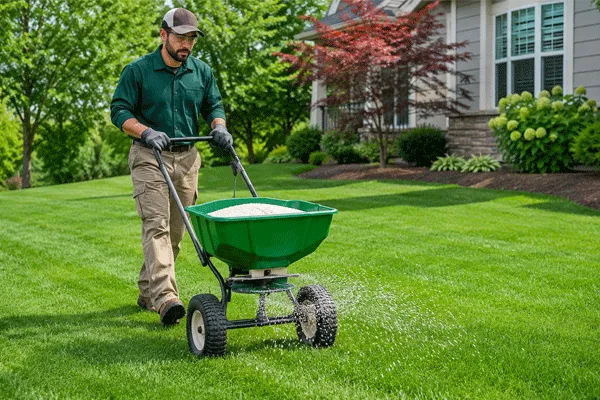
Will Ammonium Sulfate Burn a Lawn? Risks, Prevention, and Safe Use of Nitrogen Fertilizer
Yes. Ammonium sulfate can burn grass when the application rate is too high or the product is not spread and watered correctly. This is especially important because ammonium sulfate is a quick-release nitrogen fertilizer that dissolves readily in water.
When fertilizer granules dissolve, they create a concentrated salt solution around the grass leaves and roots. If the concentration becomes too high, the grass may lose water instead of absorbing it normally. This can cause leaf discoloration, dry patches, and even dead grass.
The risk is not limited to ammonium sulfate. Urea, ammonium nitrate, and calcium nitrate can also cause fertilizer injury when applied incorrectly. Cornell University identifies ammonium sulfate as a nitrogen source with relatively high turfgrass burn potential.
However, this does not mean ammonium sulfate is unsuitable for lawn care. It can provide useful nitrogen and sulfur when applied at suitable rates. The key is understanding its properties and managing the application carefully.
Ammonium sulfate is commonly sold under the grade 21-0-0, meaning it contains approximately 21% nitrogen and no declared phosphorus or potassium. Some commercial products have slightly different guaranteed analyses. For example, LVFENG offers Ammonium Sulphate 20.5-0-0+23S, which supplies 20.5% nitrogen and 23% sulfur.
The main reason is its soluble salt content. When too much ammonium sulfate accumulates around grass roots or remains on leaf surfaces, it can create an unfavorable concentration of dissolved salts.
Water naturally moves toward areas with higher dissolved salt concentrations. When fertilizer salts become too concentrated around plant tissues, water uptake becomes difficult. In severe cases, water can move out of the grass cells, causing dehydration and tissue damage.
There are two main types of injury to understand:
1. Leaf or foliar burn
This happens when fertilizer granules remain on grass blades, especially when the turf is wet or temperatures are high. The concentrated solution can damage leaf tissue and create brown tips or scorched areas.
2. Root-zone salt injury
This happens when excessive fertilizer accumulates in the soil around the roots. High salt concentrations make it harder for grass to absorb water, even when the soil contains enough moisture.
Ammonium sulfate also supplies nitrogen in the ammonium form. Soil microorganisms gradually convert ammonium into nitrate through nitrification. This process supports nitrogen availability but also produces acidity over time.
The fertilizer is therefore useful, but it should not be treated as a product that can be applied freely whenever the grass looks pale.
Not every lawn has the same risk. The grass type, soil moisture, weather, application method, and fertilizer quantity all affect the result.
| Condition | Why It Increases Risk | Recommended Action |
|---|---|---|
| Hot summer weather | Grass may already experience heat stress | Avoid high-rate applications |
| Dry soil | Grass has limited access to water | Maintain suitable soil moisture |
| Wet grass blades | Granules can stick to leaves | Apply when foliage is dry |
| Excessive application | Creates high salt concentrations | Measure the application rate |
| Uneven spreading | Creates concentrated fertilizer strips | Calibrate the spreader |
| Poor irrigation | Fertilizer remains on leaf surfaces | Water according to product instructions |
| Dormant grass | Nutrient uptake is limited | Wait for active growth |
During a hot summer, grass may already struggle to maintain water balance. Adding a quick-release nitrogen fertilizer under these conditions can increase stress.
This is especially important for warm-season grasses such as Bermuda grass. Although Bermuda grows actively during warm weather, it still needs proper irrigation and careful nutrient management.
A common mistake is applying too much fertilizer in one area. This can happen when a spreader releases too many granules, when walking paths overlap, or when fertilizer spills from a bag.
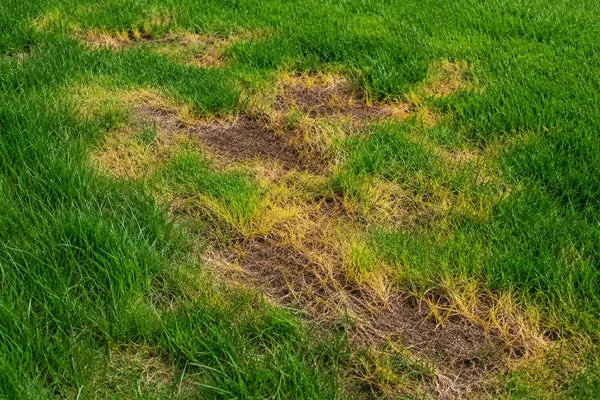
The result is often a pattern of dark-green strips beside brown or damaged grass.
If you do not water the treated area after applying ammonium sulfate, granules may remain on the grass blades. Watering helps move soluble nutrients into the soil and away from leaf surfaces.
For more general guidance on nitrogen sources and lawn feeding, see our guide to nitrogen fertilizer for lawn grass and the differences between urea, ammonium sulfate, and slow-release products.
Recognizing fertilizer burn early can help prevent further damage.
The first signs often appear as yellow, brown, or dry-looking grass blades. In more serious cases, entire patches may turn brown and stop growing.
Common symptoms include:
However, not every brown lawn has fertilizer damage. Drought, fungal diseases, poor drainage, insect activity, and dog urine can create similar symptoms.
Use the following comparison to identify possible causes:
| Symptom | Possible Cause | What to Check |
|---|---|---|
| Brown patches shortly after fertilizing | Fertilizer burn | Application records and spreader settings |
| Uniform pale-green grass | Nitrogen deficiency | Grass growth and nitrogen history |
| Brown grass during hot weather | Heat or drought stress | Soil moisture |
| Circular brown patches | Disease or urine damage | Patch shape and surrounding grass |
| Dark-green and brown stripes | Uneven fertilizer distribution | Spreader overlap |
Timing is important. If damage appears within a few days of a fertilizer application, fertilizer burn becomes a stronger possibility.
You can also review our article on how to tell if your lawn needs nitrogen before deciding whether another nitrogen application is necessary.
Will Ammonium Sulfate Burn a Lawn? Risks, Prevention, and Safe Use of Nitrogen Fertilizer
There is no single application rate that works for every lawn. The correct amount depends on grass species, soil conditions, nitrogen demand, climate, and local lawn care recommendations.
The most important step is calculating the amount of actual nitrogen rather than measuring fertilizer by bag weight alone.
For example, a typical ammonium sulfate product with a 21-0-0 analysis contains:
Use this formula:
Fertilizer required = Target nitrogen amount ÷ Nitrogen percentage
Suppose a hypothetical application program requires 0.5 lb of actual nitrogen per 1,000 square feet.
For 21-0-0 ammonium sulfate:
0.5 ÷ 0.21 = 2.38 lb of fertilizer.
For a 20.5% nitrogen product:
0.5 ÷ 0.205 = 2.44 lb of fertilizer.
These are mathematical examples, not universal lawn application recommendations. Always check local turfgrass guidance and the specific product label before applying.
The University of California Agriculture and Natural Resources notes that lawn fertilizer requirements depend on grass species, and its general guidance recommends no more than 1 lb of actual nitrogen per 1,000 square feet in a single application. Individual regional recommendations can be lower.
Applying too much ammonium sulfate does not automatically produce a greener lawn.
Excess nitrogen may cause:
A good lawn fertilizer program should focus on the grass’s actual nutrient needs, not simply on achieving the darkest possible green color.
Correct application is the most effective way to reduce fertilizer burn.
Before applying ammonium sulphate, check the weather, measure the lawn area, calculate the nitrogen requirement, and prepare the spreader.
Only fertilize when the grass is actively growing and able to use nitrogen.
Avoid feeding grass that is severely drought-stressed, dormant, or already damaged by excessive fertilizer.
Dry grass blades help granular fertilizer fall through the turf canopy and reach the soil.
Avoid spreading ammonium sulfate onto wet foliage, especially during warm weather.
A calibrated spreader helps distribute fertilizer evenly.
Before starting:
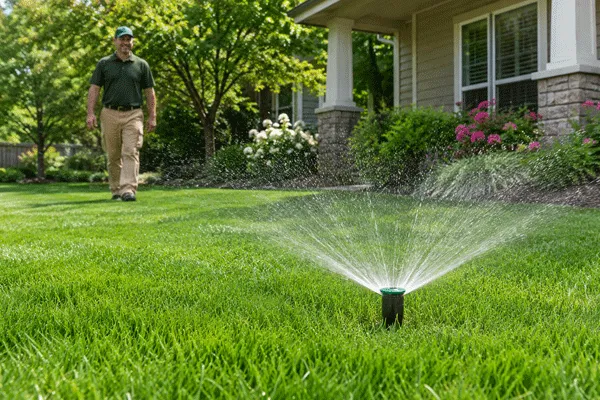
For quick-release ammonium sulfate, irrigation helps dissolve granules and move nutrients away from the leaf surfaces.
Use enough water to wash the fertilizer into the soil without creating runoff.
The University of Georgia Cooperative Extension also identifies ammonium sulfate and urea as fertilizer sources associated with foliar burn and recommends applying fertilizer at reasonable rates to dry turf, followed by normal irrigation.
Record the product analysis, application date, amount, weather, and irrigation conditions.
This information helps lawn managers identify problems and improve future applications.
For more information about seasonal nitrogen timing, read our guide to the best time to use nitrogen on grass.
Yes. Ammonium sulfate can gradually lower soil pH through the nitrification process.
When soil microorganisms convert ammonium nitrogen into nitrate, they release hydrogen ions. Over repeated applications, this can increase soil acidity.
This property can be useful in some alkaline soils, particularly where grass grows poorly because high pH limits the availability of certain nutrients.
However, it does not mean every lawn needs ammonium sulfate.
If your soil is already acidic, repeated use may make the condition worse. Excessive acidity can affect nutrient availability and root development.
The relationship between ammonium sulfate and soil pH is especially important for long-term lawn management.
| Soil Condition | Ammonium Sulfate Consideration |
|---|---|
| Alkaline soil | May be useful as an N and S source |
| Neutral soil | Monitor pH during repeated use |
| Acidic soil | Avoid unnecessary acidifying inputs |
| Unknown pH | Test before creating a long-term program |
One important point: the sulfur in ammonium sulfate is not the main cause of soil acidification. The acidity develops mainly from the transformation of ammonium nitrogen during nitrification.
Therefore, a soil test should guide long-term use. Do not use ammonium sulfate simply to change soil pH without understanding the current condition.
If you notice fertilizer burn, act quickly.
The first goal is to reduce the concentration of soluble salts around the roots and remove fertilizer residues from the grass blades.
Do not add more ammonium sulfate, urea, or another nitrogen source to the damaged area.
Additional fertilizer can increase stress.
If excessive fertilizer was applied, irrigate the affected area thoroughly.
Water helps dilute and move excess soluble salts through the soil profile. Where drainage allows, repeated irrigation may help reduce the concentration around the roots.
The University of Maryland Extension recommends soaking overfertilized areas with approximately 1-inch applications of water, repeated two or three times, to help leach excess salts. Avoid creating runoff or waterlogging.
Avoid additional nitrogen applications until the grass shows signs of recovery.
Maintain suitable soil moisture and continue normal mowing practices when the turf can tolerate them.
If the grass has died, watering alone may not restore it.
You may need to remove dead material, prepare the soil, and reseed or replace the damaged turf.
Choose a grass variety suitable for your local climate and growing conditions.
Check the amount applied, fertilizer concentration, spreader settings, weather, and irrigation.
This will help identify the cause and prevent the same problem from happening again.
For additional guidance on weather-related fertilizer loss and irrigation, see should you fertilize your lawn before or after rain?.
Ammonium sulfate is not the only nitrogen source available for lawn care.
Different products have different nitrogen concentrations, nutrient contributions, and release characteristics.
| Nitrogen Source | Typical Nitrogen Content | Main Characteristics | Burn Consideration |
|---|---|---|---|
| Ammonium sulfate | 21% | Supplies nitrogen and sulfur | High if misapplied |
| Urea | 46% | Concentrated, quick-release nitrogen | High if misapplied |
| Ammonium nitrate | 33–34% | Supplies ammonium and nitrate nitrogen | Requires careful rate control |
| Calcium nitrate | About 15.5–16% | Supplies nitrate nitrogen and calcium | Can cause injury if overapplied |
| Slow-release urea | Varies | Gradual nitrogen release | Generally lower when properly formulated |
Urea contains much more nitrogen per kilogram than ammonium sulfate.
This means you need less urea to supply the same amount of nitrogen. However, urea also has fertilizer burn risks when applied incorrectly.
Ammonium sulfate offers an additional benefit: sulfur nutrition.
Ammonium nitrate and calcium nitrate supply nitrogen in nitrate-containing forms.
Nitrate is readily available to plants but can move through the soil with water. Calcium nitrate also supplies calcium, which may be useful in certain nutrient programs.
Slow-release fertilizers provide nitrogen over a longer period.
They can help maintain more consistent grass growth and reduce the risk of sudden nutrient concentration increases when used correctly.
However, no nitrogen source is completely free from fertilizer injury. Application rate and management remain important.
For lawn fertilizer distributors and turf management brands, understanding these differences helps create a more useful product range rather than relying on one nitrogen source for every customer.
Will Ammonium Sulfate Burn a Lawn? Risks, Prevention, and Safe Use of Nitrogen Fertilizer
Ammonium sulfate can be a useful nitrogen source for lawns, but it is not automatically the best choice for every situation.
It is particularly relevant when a lawn needs nitrogen and sulfur, and when the soil condition supports the use of an acid-forming nitrogen source.
It may be less suitable when the soil is already acidic, the grass is drought-stressed, or the user cannot control application rates and irrigation.
For example, Bermuda grass managers may use quick-release nitrogen during active growth, while cool-season turf managers often follow a different seasonal program. In both cases, the correct amount matters more than simply choosing a high-nitrogen product.
For agricultural distributors, importers, lawn care companies, and fertilizer brand owners, product selection involves more than nitrogen concentration.
Consider the following:
| Purchasing Factor | Why It Matters |
|---|---|
| Nitrogen concentration | Determines the required product rate |
| Sulfur content | Adds a secondary nutrient benefit |
| Granule size | Supports even spreading |
| Moisture content | Affects storage and caking |
| Product consistency | Helps maintain repeatable quality |
| Packaging | Supports retail and bulk distribution |
| OEM options | Helps build a local fertilizer brand |
| Quality documentation | Supports product registration and procurement |
As a China-based fertilizer manufacturer and exporter, SHANDONG LVFENG FERTILIZER CO., LTD. supplies ammonium sulphate and other fertilizer products for global agricultural markets.
Our ammonium sulphate product is specified at 20.5% nitrogen and 23% sulfur, with granular specifications and quality testing. We also support customized packaging and OEM cooperation for distributors, importers, and fertilizer brands.
For buyers developing a lawn fertilizer portfolio, the goal should be to select a suitable nitrogen source based on local turf requirements, product regulations, and customer application habits.
Explore our OEM fertilizer manufacturing and private-label customization service to discuss product specifications, packaging, and bulk supply requirements.
Yes. Excessive application can create high salt concentrations around grass roots and leaves, leading to dehydration, brown patches, and severe turf damage. Correct application and irrigation reduce the risk.
It can be used as a nitrogen and sulfur source when Bermuda grass is actively growing and the product is suitable for the application. Avoid excessive rates, drought-stressed turf, and poor irrigation practices.
Yes. Watering after application helps dissolve the granules and move fertilizer away from grass blades into the soil. Follow the product label and avoid excessive irrigation.
Yes. Repeated applications can gradually lower soil pH because ammonium nitrogen releases acidity during nitrification. Monitor soil pH before using it regularly.
Neither is always better. Ammonium sulfate supplies nitrogen and sulfur, while urea has a higher nitrogen concentration. The best choice depends on soil conditions, grass requirements, fertilizer rates, and the management program.
Mild damage may improve as new grass growth develops over the following weeks. Severe damage may require reseeding or turf replacement. Recovery depends on grass species, root damage, weather, and soil conditions.
Looking for a reliable ammonium sulphate fertilizer manufacturer in China? LVFENG provides nitrogen and sulfur fertilizer products, customized packaging, OEM services, and bulk export support for agricultural distributors, importers, commercial farms, and fertilizer brands.