Avoid your inquiry is delay response, please enter your WhatsApp/Skype along with the message, so we can contact you at the very first time.
We will reply you within 24 hours. If for urgent case, please add WhatsApp/WeChat: ,. Or call directly.
You apply fertilizer, but how long are those nutrients really available to the crop? Rain, irrigation, soil texture, fertilizer form, and plant uptake can all change the answer. Without understanding these factors, farms may apply too early, too late, or simply use more fertilizer than the crop needs.
So, how long does fertilizer last in soil? There is no single fixed period. Nitrogen may move or be lost relatively quickly, while phosphorus and potassium often remain in the soil much longer. Liquid fertilizer usually releases nutrients quickly, while granular, organic, and controlled-release products may feed plants over a longer period. Soil type, moisture, temperature, crop uptake, and fertilizer formulation determine the actual duration.
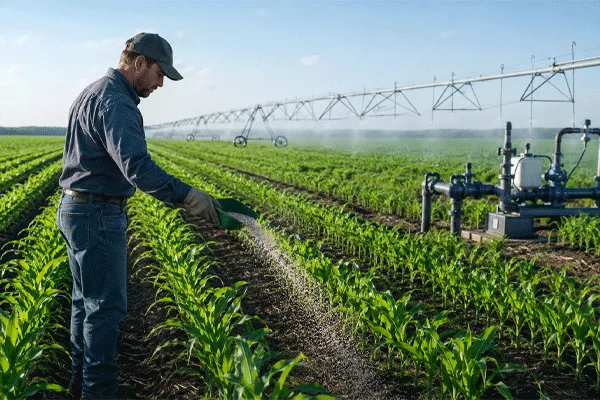
How Long Does Fertilizer Last in Soil? NPK Fertilizer Longevity Explained
The short answer is that NPK fertilizer does not have one universal lifespan in soil. When people ask how long fertilizer lasts in soil, they often imagine the whole fertilizer granule remaining active for a fixed number of days. Soil chemistry does not work that way.
An NPK fertilizer supplies nitrogen, phosphorus, and potassium. Each nutrient behaves differently after application. Nitrogen is generally more mobile, especially after it converts to nitrate. Phosphorus is much less mobile because it reacts with soil minerals. Potassium also tends to move more slowly in medium- and fine-textured soils, although it can move farther in sandy soils. University of Minnesota Extension describes nitrate as vulnerable to leaching and phosphorus and potassium as relatively immobile nutrients.
A practical comparison looks like this:
| Nutrient | General Soil Behavior | Main Factors Affecting Persistence |
|---|---|---|
| Nitrogen (N) | Relatively mobile | Rainfall, irrigation, temperature, soil texture, microbial activity |
| Phosphorus (P) | Low mobility | Soil pH, fixation, crop uptake, erosion |
| Potassium (K) | Low to moderate mobility | Clay content, soil texture, rainfall, crop removal |
| Controlled-release NPK | Gradual nutrient release | Coating, moisture, temperature, formulation |
| Organic fertilizer | Nutrients released through decomposition | Temperature, moisture, microbes, material composition |
This is why knowing how long a fertilizer works requires more than reading the N-P-K numbers on a bag.
For buyers who need multiple nutrients in one formulation, our NPK compound fertilizer range provides different nutrient combinations for commercial agricultural programs.
Nitrogen deserves the most attention when discussing how long fertilizer lasts in soil. Once nitrogen exists as nitrate, water can move it through the root zone. Coarse or sandy soil has less water-holding capacity than many clay or silt soils, which can increase nitrate-leaching risk. Heavy rainfall and excess irrigation can speed this process.
Phosphorus behaves very differently. It is considered relatively immobile in most agricultural soils. It can react with iron and aluminum in acidic soils or calcium in alkaline conditions, reducing immediate plant availability. This does not necessarily mean the phosphorus has disappeared. Instead, part of the fertilizer remains in soil forms that roots may access differently over time. Penn State Extension notes that phosphorus does not move very far through soil toward plant roots.
Potassium falls between these two behaviors. It tends to remain near the application zone in medium- and fine-textured soil but may leach more easily from sandy, acidic soils with low organic matter.
In simple terms:
Nitrogen → higher mobility
Potassium → moderate to low mobility
Phosphorus → low mobility
This difference is more useful than trying to claim that all NPK fertilizers will last for the same number of weeks.
A liquid fertilizer often delivers soluble nutrients that become available quickly. This can make liquid or water-soluble products useful when crops require rapid nutrient delivery through irrigation or other application systems.
You may see general statements that liquid fertilizer can last 1 to 2 weeks or that another product may last for 2 to 6 weeks. These figures should not be treated as universal rules. Whether liquid fertilizers may continue supplying useful nutrients depends on nutrient form, application rate, crop demand, rainfall, irrigation, and soil conditions.
The same principle applies to synthetic liquid fertilizers, liquid mineral fertilizers, and liquid organic fertilizers. A liquid format does not automatically tell you how long every nutrient will remain available.
A granular fertilizer, by comparison, must normally dissolve before soluble nutrients can move into the soil solution. Some conventional granules dissolve relatively quickly after sufficient moisture arrives. Other products are designed to release nutrients more slowly.
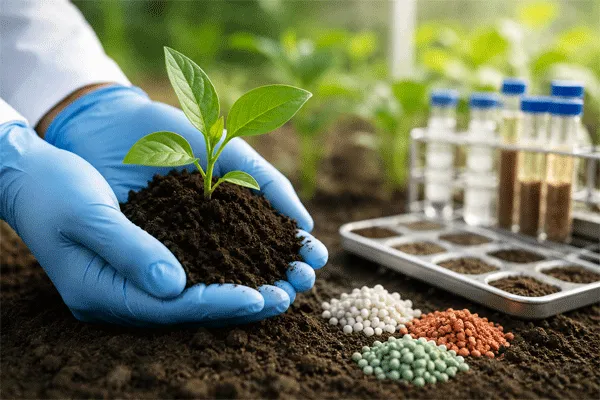
How Long Does Fertilizer Last in Soil? NPK Fertilizer Longevity Explained
| Fertilizer Form | Typical Release Character | Useful For |
|---|---|---|
| Liquid fertilizer | Fast nutrient availability | Fertigation, rapid feeding |
| Water-soluble fertilizer | Fast after dissolution | Irrigation and intensive cropping |
| Conventional granular fertilizer | Dissolves after soil moisture contact | Broad agricultural use |
| Controlled-release fertilizer | Gradual release | Programs needing extended feeding |
| Organic granular fertilizer | Depends on decomposition | Soil and nutrient management programs |
Commercial farms using irrigation can explore our water-soluble NPK fertilizer portfolio when choosing the appropriate nutrient delivery method.
Soil type can dramatically affect fertilizer longevity.
A sandy type of soil allows water to pass through more rapidly. That can carry nitrate deeper into the profile and potentially below crop roots. In contrast, a clay soil generally has greater nutrient-holding capacity, although drainage, soil structure, and rainfall still matter.
University of Minnesota Extension explains that coarse-textured soils generally have greater nitrate-leaching potential because they hold less water than finer-textured soils.
Consider two fields receiving the same nitrogen fertilizer:
The nitrogen in Field A may move through the rooting zone faster. Yet phosphorus behavior may be very different because phosphorus movement in either field remains relatively limited.
Moisture also matters. Damp soil can help dissolve fertilizer and support microbial activity, while very dry soil may delay nutrient movement and plant uptake. Excess water, however, can increase nutrient loss.
This is why the answer to “how long does fertilizer last?” should always include another question:
What soil and environmental conditions are we dealing with?
An organic fertilizer usually depends partly on biological decomposition before all nutrients become plant available. Microorganisms break down organic material, and the speed changes with temperature, moisture, aeration, and the original material.
As a result, asking how long it takes fertilizer to decompose does not produce one reliable number. Warm, biologically active soil may release nutrients faster than cold or dry soil.
A control release fertilizer, more commonly called controlled-release fertilizer, works differently. A coating or another release mechanism regulates how quickly nutrients move into the root environment. Purdue Extension notes that controlled-release fertilizer longevity is closely linked to substrate temperature and moisture, with expected longevity normally indicated by the product specification.
Therefore, certain controlled-release products may last significantly longer than immediately soluble products. Organic materials may also last much longer in the soil system because their nutrients move through mineralization and decomposition processes.
For buyers seeking mineral nutrients together with organic material, our organic-inorganic compound fertilizer solutions provide another sourcing category to evaluate.
“Does fertilizer go bad?” is actually a different question from how long fertilizer stays active after field application.
Many properly stored dry fertilizer products can remain usable for long periods because the mineral nutrients themselves do not suddenly disappear. Some materials are sometimes described as able to last indefinitely, but storage quality still matters. Moisture can cause caking, segregation, contamination, or handling problems.
For example, Purdue Extension notes that several nitrogen fertilizer materials can absorb moisture and should be kept protected during storage.
A dry granular fertilizer or dry crystallized fertilizer should generally be protected from:
A wet fertilizer that was intended to remain dry may still contain nutrients, yet its physical quality and ease of application can deteriorate.
Liquid products require product-specific storage practices. Their stability depends on formulation, concentration, temperature, and manufacturer requirements. Therefore, liquid fertilizers typically should be managed according to their technical specification rather than a generic shelf-life assumption.
For an importer, fertilizer shelf life is therefore both a chemical and a logistics question. Before placing a large order, ask how to store fertilizer, whether temperature limitations apply, and how the packaging protects it during shipping and warehousing.
Once fertilizer is applied to the soil, several processes begin at the same time.
Some nutrients dissolve. Roots absorb part of them. Soil particles retain part of them. Microorganisms transform certain nutrients. Water can carry mobile nutrients downward. Surface runoff or erosion can also remove nutrients under certain conditions.
So the amount of time fertilizer remains in the soil is not the same as the amount of time it remains immediately available to plants.
Consider this simplified nutrient-flow chart:
Fertilizer Application
        ↓
Dissolution / Transformation
        ↓
Soil Nutrient Pool
   ↙       ↓        ↘
Plant   Retention   Loss
Uptake   in Soil   Pathways
As crops grow, nutrients from the fertilizer deplete through plant uptake and harvest removal. Yet unused phosphorus or potassium can sometimes contribute to measurable soil nutrient reserves.
This explains why adding fertilizer every few weeks without testing is not automatically good management. More input does not always equal more yield.
The better goal is to apply fertilizer when crop demand, soil nutrient status, product formulation, and application method support it.
Soil testing is one of the best tools for determining whether more fertilizer is actually needed.
A laboratory soil test can help evaluate nutrient status, pH, and other factors that influence fertilizer effectiveness. It is especially valuable for phosphorus and potassium because both can accumulate in soil when inputs repeatedly exceed crop removal.
University of Minnesota describes soil testing as a way to classify the relative level of immobile nutrients and develop fertilizer recommendations.
Instead of asking:
“Should we apply new fertilizer because the previous application was three months ago?”
Ask:
“What does the soil test show, what will the crop remove, and what nutrient rate is economically justified?”
This approach can sometimes mean less fertilizer, not more.
A strong nutrient plan usually considers:
For customers who want flexible physical blends and targeted formulas, our NPK blending fertilizer solutions can support different market and crop requirements.
For a distributor or commercial farm, choosing the right fertilizer involves more than asking which product lasts longest.
A fast-release water soluble fertilizer may be the proper fertilizer for a greenhouse fertigation program. A granular NPK compound fertilizer may better match another farming system. A specific potassium fertilizer or phosphate fertilizer may be required when soil testing identifies a nutrient need.
The type of fertilizer you use should match the application system and commercial objective.
As a China-based manufacturer and exporter of fertilizer products, we work from the buyer’s end-use requirement first. For our main customer groups, that means different questions:
| Buyer Type | Main Questions |
|---|---|
| Agricultural distributors & importers | Which formulas suit local crops and market demand? |
| Commercial farms & cooperatives | What nutrient balance matches soil tests and production goals? |
| Government & NGO projects | What specification, packaging, and supply plan are required? |
| Fertilizer brand owners | Is custom formulation, packaging, or private labeling needed? |
Imagine an agricultural distributor serves open-field grain growers, fruit farms, and vegetable greenhouses.
Buying one all-purpose plant fertilizer for every customer seems simple. It may not be commercially effective.
The distributor may instead require:
That is where understanding how long each nutrient behaves in the target field helps buyers build a better product portfolio.
How Long Does Fertilizer Last in Soil? NPK Fertilizer Longevity Explained
A professional fertilizer supplier should receive more information than the sentence, “Please quote NPK.”
If you contact an NPK fertilizer wholesaler or manufacturer, provide enough detail for the supplier to understand your real use case.
We recommend preparing:
For example, a farm needing rapid fertigation and an importer buying conventional granular material are purchasing very different solutions even if both products contain fertilizer nutrients N, P, and K.
Fertilizer sourcing becomes more reliable when the specification reflects the application.
Buyers looking for separate nitrogen products can review our nitrogen fertilizer product range. Fertilizer brand owners requiring custom formulas or packaging can also explore our custom fertilizer OEM services.
There is no fixed duration for all NPK fertilizers. Nitrogen can move or be lost relatively quickly, particularly in nitrate form under wet conditions. Phosphorus moves very slowly in most soils, while potassium is generally less mobile except in some sandy soils. Product formulation, crop uptake, climate, and soil conditions determine actual fertilizer longevity.
Not necessarily. Statements that a liquid fertilizer will last anywhere from one week to several weeks are rough generalizations, not universal agronomic rules. Nutrient form, crop demand, soil, rainfall, irrigation, and application rate all affect how long fertilizer remains available.
It can, depending on the formulation. Some granular products release nutrients gradually, while immediately soluble products become available faster. A controlled-release granular product can last for several weeks or months according to its release design. Conventional granules should not automatically be assumed to have the same longevity.
Whether lawn fertilizer expire concerns storage rather than soil persistence. Many dry mineral fertilizers remain chemically useful for long periods when stored properly, although moisture and poor storage can cause caking or handling problems. Always follow the individual product’s storage guidance.
An old fertilizer may still contain usable nutrients if it has been stored correctly and has not been contaminated or physically degraded. Before using it, inspect packaging and product condition and confirm any product-specific shelf-life recommendations. In commercial agriculture, reliable specifications matter more than simply assuming fertilizer can still be effective.
The correct schedule depends on crop system, region, management intensity, and local agronomic recommendations. Rather than automatically adding fertilizer to your lawn or field at a fixed interval, test soil according to an appropriate crop management program and use the results to guide nutrient decisions.