Avoid your inquiry is delay response, please enter your WhatsApp/Skype along with the message, so we can contact you at the very first time.
We will reply you within 24 hours. If for urgent case, please add WhatsApp/WeChat: ,. Or call directly.
Choosing a fertilizer can become confusing when labels list numbers, chemical names, and different nutrient ratios. Pick the wrong balance, and crops may not receive what they need. The solution starts with understanding three essential nutrients: nitrogen, phosphorus, and potassium, commonly called N-P-K.
The three main chemicals in fertilizer are commonly described as nitrogen (N), phosphorus (P), and potassium (K). More precisely, they are three primary plant nutrients rather than three individual fertilizer chemicals. Commercial products supply them through compounds such as urea or ammonium sources, phosphates, potassium chloride, and potassium sulfate. Together, these three macronutrients support healthy crop development and productive farming. FAO and IFA identify N, P, and K as the primary nutrients used in modern fertilization.
The three essential nutrients most people mean when they ask about the main chemicals in fertilizer are nitrogen, phosphorus, and potassium. They are often called the three primary macronutrients because crops generally need them in larger quantities than micronutrient elements such as zinc, boron, copper, or manganese. FAO describes the primary nutrients in the same N-P-K framework.
| Nutrient | Symbol | Common Fertilizer Sources | Main Agricultural Role |
|---|---|---|---|
| Nitrogen | N | Urea, ammonium forms, ammonium nitrate | Vegetative growth, proteins, chlorophyll |
| Phosphorus | P | Phosphate fertilizers, MAP, DAP | Energy transfer, roots, crop development |
| Potassium | K | Potassium chloride, potassium sulfate, potassium nitrate | Water regulation, enzyme activity, crop strength |
These are the main components behind many compound and blended products. However, fertilizers contain nutrient compounds rather than bags of pure elemental N, P, and K.
This distinction matters when comparing fertilizer ingredients. A product may deliver phosphorus through phosphate compounds or potassium through potash fertilizers. What matters agronomically is the available nutrient supplied to the crop.
For buyers looking for several nutrients in one granule, our NPK compound fertilizer range is the logical place to compare multi-nutrient formulations.
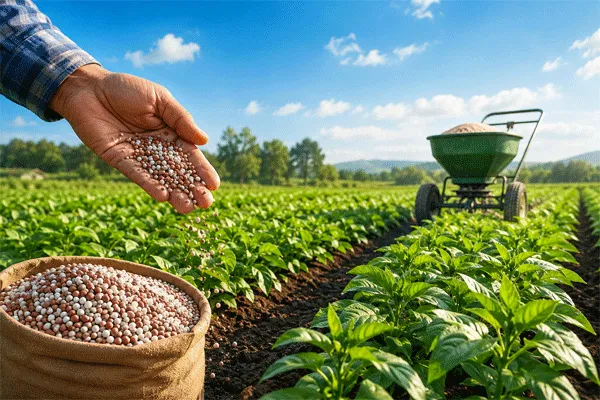
What Are the Three Main Chemicals in Fertilizer? A Guide to Nitrogen, Phosphorus, and Potassium Nutrients
Nitrogen is closely linked to active vegetative development. Plants use it to build amino acid compounds and proteins, and nitrogen is also part of chlorophyll, the green pigment involved in photosynthesis.
This is why a crop with strong vegetative demand may require a higher amount of nitrogen during particular growth stages. Yet more is not automatically better. High nitrogen applications that do not match actual plant needs can reduce nutrient-use efficiency and create unnecessary cost.
Nitrogen is found in many forms of commercial fertilizer, including urea and ammonium-based materials. Ammonia is used as a major industrial starting point for producing nitrogen fertilizer products. According to IFA, industrial ammonia production combines nitrogen obtained from air with hydrogen; conventional production has commonly obtained that hydrogen from natural gas, although other pathways are also being developed.
A simplified production chain looks like this:
Air → Nitrogen → Ammonia → Nitrogen-Based Fertilizer → Farm Application
For importers or distributors sourcing this category separately, see our nitrogen fertilizer products.
Phosphorus is another primary macronutrient. It is involved in energy transfer inside plants and supports important development processes throughout the crop life cycle.
Unlike industrial nitrogen, phosphorus begins with a mineral resource. Phosphate rock is extracted from a mine and processed into materials that can supply phosphorus in a form suitable for agricultural production.
The International Fertilizer Association explains that mined rock can be treated with acid to produce phosphoric acid, which then becomes a starting material for different phosphorus fertilizer products. USGS likewise notes that treating phosphate rock with sulfuric acid is a major route for producing phosphoric acid for fertilizer manufacturing.
This route is commonly known as the wet process.
Phosphate rock → acid treatment → phosphoric acid → phosphorus fertilizer
Other acids and chemical intermediates may be involved in wider fertilizer manufacturing systems. The important point for a fertilizer buyer is simpler: phosphorus originates mainly from mineral phosphate resources and is converted into plant-available forms through controlled chemical processes.
Potassium completes the familiar N-P-K group. It participates in many plant functions, including water regulation and enzyme activity, and supports normal crop development under changing field conditions.
Agricultural potassium mainly comes from mineral deposits known collectively as potash. The U.S. Geological Survey describes potash as a major source of soluble potassium and identifies potassium as one of the three primary plant nutrients.
Common sources include:
USGS notes that agricultural potash includes potassium chloride, potassium sulfate, and related potassium-bearing products.
The best potassium used in a program depends on crop requirements, soil conditions, nutrient strategy, and the complete formula. This is one reason distributors and commercial farms should evaluate the whole N-P-K profile instead of buying based on one nutrient alone.
Although we often talk about N, P, and K together, their raw materials and production routes are very different.
| Nutrient | Main Starting Source | Simplified Production Route |
|---|---|---|
| N | Air + hydrogen source | Ammonia production followed by fertilizer conversion |
| P | Phosphate rock | Mining, acid treatment, phosphoric acid or phosphate processing |
| K | Potash deposits | Mining, separation, purification, sizing or further processing |
Nitrogen manufacturing uses industrial synthesis. Nitrogen from air and hydrogen are combined to form ammonia through an industrial reaction using pressure, temperature, and a catalyst. The ammonia can then become different nitrogen fertilizer materials.
Phosphorus and potassium are different because their starting resources are mined. Fertilizers are obtained from these resources after concentration and processing. Phosphate production may use sulfuric acid during the conversion of rock into phosphoric acid, while potash processing concentrates useful potassium salts.
These several chemical processes explain why saying that all fertilizers are simply “chemicals” hides an important point: every nutrient has its own supply chain and production process.
For buyers who need highly soluble nutrient delivery, our water-soluble NPK fertilizer portfolio provides another way to evaluate different N-P-K balances.
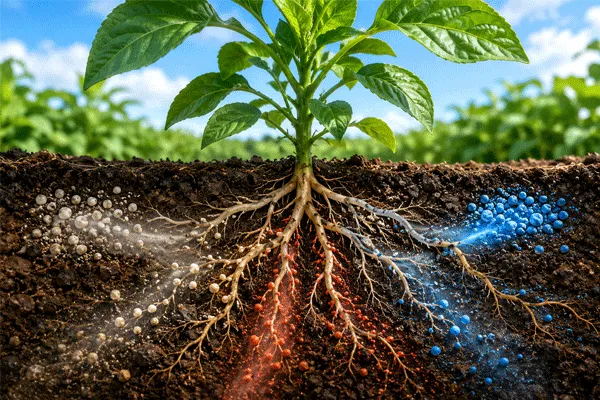
What Are the Three Main Chemicals in Fertilizer? A Guide to Nitrogen, Phosphorus, and Potassium Nutrients
The three numbers printed on an N-P-K label show the declared concentration of primary nutrients in a fixed order:
N – P – K
For example:
15-15-15
The first number represents nitrogen. The second represents phosphorus content under the labeling convention used for the market, and the third represents potassium content under the applicable convention.
In many international fertilizer systems, phosphorus and potassium declarations are expressed as P₂O₅ and K₂O equivalents rather than as elemental P and K. Buyers should therefore read technical specifications and local labeling rules rather than assuming that every market declares nutrients in exactly the same way. FAO fertilizer statistics also commonly report phosphorus as P₂O₅ and potassium as K₂O.
Consider a few simple formulation patterns:
| N-P-K Pattern | General Nutrient Character |
|---|---|
| 15-15-15 | Balanced N-P-K |
| 20-10-10 | Higher nitrogen |
| 10-20-10 | Higher phosphorus |
| 10-10-20 | Higher potassium |
These examples illustrate nutrient ratios, not universal crop recommendations. A suitable fertilizer applied to one crop, soil, or growth stage may not be suitable for another.
For buyers who prefer physical nutrient blending and flexible formulas, explore our NPK blending fertilizer solutions.
N-P-K may be the best-known three nutrients, but crops need more than three elements.
Other macronutrient or secondary nutrient requirements may include sulfur and magnesium, while micronutrient programs may involve zinc, boron, manganese, iron, copper, molybdenum, and other elements depending on crop and soil conditions. IFA notes that plant nutrition extends beyond N-P-K and includes additional nutrients required in smaller amounts.
That is why two products with similar N-P-K ratios may still serve different purposes.
For example, one formulation may include sulfur. Another may include magnesium or a micronutrient package. A crop-specific program should consider soil analysis, crop stage, climate, water quality, and expected yield rather than treating N-P-K as the complete nutrition story.
This is also where fertilizer sourcing becomes more technical. Agricultural distributors often need formulas suitable for different regional crops. Government projects may require clear nutrient specifications. OEM brand owners may want a product specification that fits a particular market position.
Our organic-inorganic compound fertilizer category provides another option for buyers evaluating combinations of mineral nutrients and organic materials.
There are many types of fertilizers, and the most useful classification depends on whether you are discussing nutrient source, physical form, solubility, or application method.
At a broad level, products may include:
A mineral fertilizer supplies nutrients from processed mineral or industrial sources. Organic fertilizers may obtain nutrients from materials such as animal manure, compost, and other biological materials.
These categories are not interchangeable. A grower using fertigation may prioritize solubility. A broad-acre farm may prioritize granular handling and nutrient economics. A distributor may need several fertilizer types to serve different market segments.
The right question is therefore not, “Which fertilizer is best?” It is:
Which nutrient form, concentration, physical format, and formula fit the crop, soil, application system, and commercial objective?
There is no simple winner.
Organic fertilizers and manufactured mineral products can both supply useful plant nutrients, but they differ in nutrient concentration, release behavior, handling, consistency, and their effects on soil organic matter.
Materials such as compost and animal manure can return organic matter and nutrients to agricultural soils. Manufactured inorganic fertilizers, meanwhile, can supply defined nutrient concentrations that are easier to calculate when a precise program is required.
IFA describes integrated soil nutrition as an approach that can combine farm nutrient sources such as manure or compost with mineral products when additional nutrients are required.
So, rather than framing the issue as organic fertilizers versus chemical fertilizers, commercial buyers should ask what each nutrient source contributes to the complete production system.
For a large farm, that may mean combining soil-building practices with precise mineral nutrition. For a distributor, it may mean offering several product families for different customer groups.
The use of fertilizer should begin with what the crop and soil actually require.
A soil test can help identify existing nutrient levels. Crop type and growth stage then help determine which nutrient balance makes sense. Application equipment matters too. A water-soluble product intended for fertigation has different handling requirements from a conventional granular product.
IFA summarizes efficient nutrient management through the 4R approach:
The objective is to give crops the nutrients they require while reducing unnecessary loss.
| Question | Why It Matters |
|---|---|
| What crop will be grown? | Different crops have different nutrient demand |
| What does the soil analysis show? | Existing fertility changes the required formula |
| What growth stage is being targeted? | Nutrient balance can change through the season |
| How will the product be applied? | Granular, irrigation, foliar, and other systems differ |
| What nutrient declaration is required locally? | Regulations and labels vary by market |
| Is a custom formula needed? | Commercial programs may require specific N-P-K ratios |
| Is private labeling required? | Important for distributors and fertilizer brand owners |
This approach turns fertilizer application into a nutrient-management decision instead of a simple price comparison.
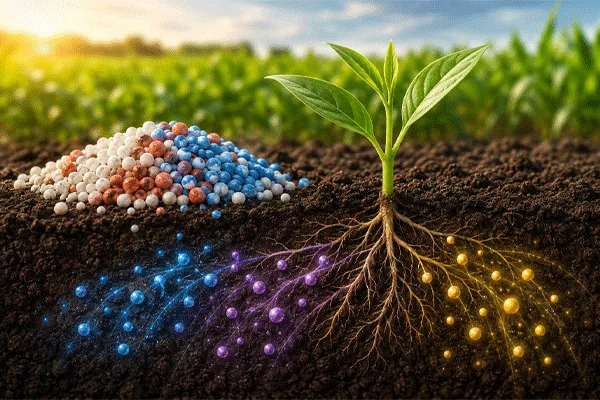
What Are the Three Main Chemicals in Fertilizer? A Guide to Nitrogen, Phosphorus, and Potassium Nutrients
For a farmer buying a few bags, product selection may be the main concern. For an importer ordering container-scale volumes, the decision is much broader.
As a China-based manufacturer and exporter of fertilizer products, we see four very different buying priorities among our target customers.
Agricultural distributors and importers need formulas that fit local market demand and product positioning. They also need clear specifications so products can be compared before purchasing.
Commercial farm owners and cooperatives are more focused on crop nutrition, application methods, and matching nutrient ratios to production goals.
Government and NGO agricultural projects often require a clearly defined product specification so procurement teams can evaluate offers consistently.
Fertilizer brand owners may need OEM supply, custom formulas, packaging options, or private-label cooperation. Buyers exploring this model can review our custom fertilizer OEM services.
Imagine a distributor serves three customer groups: cereal farms, vegetable greenhouses, and fruit growers.
Buying one formula for all three markets may appear simple, but nutrient demand and application methods differ. A stronger portfolio could include a general granular N-P-K product, a high-solubility formulation for fertigation, and one or more targeted nutrient ratios.
The lesson is simple: successful fertilizer procurement begins with the end-use market, not the product catalogue.
When contacting a manufacturer, provide as much of the following information as possible:
That information helps turn an inquiry into a useful fertilizer proposal.
Nitrogen, phosphorus, and potassium are central to modern food and agriculture because crops continuously remove nutrients from the field when biomass and harvested products leave the farm.
Some nutrients come from the soil, while plants also obtain important elements such as carbon, hydrogen, and oxygen through air and water. However, agricultural soils may not always supply enough available N, P, K, or other nutrients to meet the production target.
This is why fertilizer is also part of a wider soil fertility strategy rather than simply “plant food in a bag.”
The FAO maintains production, trade, and agricultural-use data for the three primary nutrients — nitrogen, phosphorus, and potassium — showing how central these nutrients are to the international fertilizer industry.
For distributors, projects, cooperatives, and fertilizer brands, this creates an important sourcing principle:
Do not purchase a formula simply because the N-P-K numbers look familiar. Purchase a nutrient solution that matches your market, crop, soil, application method, and specification.
The three main fertilizer nutrients are nitrogen, phosphorus, and potassium, commonly abbreviated as N-P-K. Technically, they are nutrient elements. Commercial products supply them through chemical compounds such as urea, phosphates, potassium chloride, or potassium sulfate. FAO and IFA classify N, P, and K as the primary plant nutrients.
N-P-K identifies nitrogen, phosphorus, and potassium in that order. Fertilizers are labeled with nutrient values so buyers can compare formulations. Depending on the regulatory system, phosphorus and potassium may be declared using P₂O₅ and K₂O equivalents.
Nitrogen is extremely important, but it should not automatically be considered more important than phosphorus or potassium. The crop requires balanced nutrition. The limiting nutrient depends on the soil, crop, growth stage, and production conditions.
Ammonia is a major intermediate in the production of fertilizers that supply nitrogen. Industrial ammonia is made by combining nitrogen with hydrogen and can then be converted into other nitrogen-containing products.
Most mineral phosphorus fertilizer begins with mined phosphate rock. The rock can be treated with acid to produce phosphoric acid, which is then used to manufacture phosphate products.
Most commercial potassium fertilizer begins with potash mineral resources extracted from the earth. Potassium chloride is one of the major agricultural potash products, while potassium sulfate and other potassium salts are also used.
Knowing the chemicals used in fertilizer is only the first step. Commercial sourcing requires you to turn that knowledge into the right formula, product format, packaging, and supply plan.
As a leading fertilizer manufacturer and exporter based in China, we work with agricultural distributors, commercial farms and cooperatives, agricultural projects, and OEM fertilizer brands that need dependable product sourcing and customized nutrient solutions.
If you already know your required N-P-K ratio, send us the specification. If you are comparing several formulas, tell us the target crop, country, application method, and commercial requirements.
That gives us a much stronger starting point for discussing the fertilizer products that fit your business.