Avoid your inquiry is delay response, please enter your WhatsApp/Skype along with the message, so we can contact you at the very first time.
We will reply you within 24 hours. If for urgent case, please add WhatsApp/WeChat: ,. Or call directly.
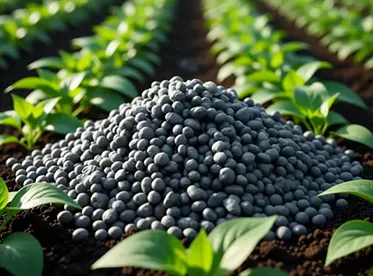
Choosing fertilizer by NPK numbers alone can be risky. Two products may both show 15-15-15, yet their manufacturing process, nutrient distribution, granule structure, handling, and application performance may differ. Understanding mixed fertilizer, compound fertilizer, and complex fertilizer helps growers and buyers choose the right product.
The main difference is how the fertilizer is made. Mixed fertilizer is produced by physically blending two or more fertilizer materials, while complex fertilizer is produced through chemical reactions or integrated granulation so multiple nutrients are present within the same granule. Both may belong to the broader compound fertilizer category, but they differ in nutrient uniformity, production method, flexibility, and cost.
For agricultural distributors, importers, large farms, cooperatives, government projects, and fertilizer brand owners, this difference matters. You are not simply buying an NPK number. You are buying a nutrient delivery system.
As a China-based manufacturer and exporter of high-quality fertilizer products, we see buyers compare formulas such as 15-15-15, 20-10-10, or 12-12-17. Yet one of the first questions we recommend asking is simpler:
How was this fertilizer made?
That question tells you a great deal about how consistently nutrients are distributed, how flexible the formula can be, and which fertilizer may fit your crop and market.
Mixed Fertilizer vs Compound Fertilizer: What Is the Difference Between Mixed and Complex Fertilizer?
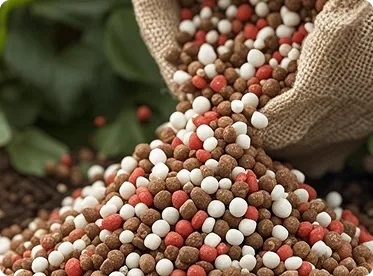
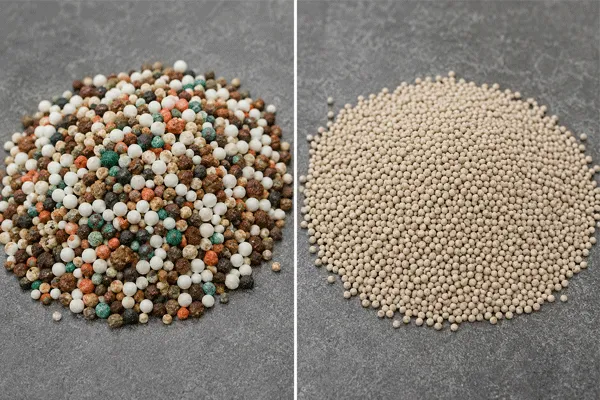
A mixed fertilizer is produced mainly by physically combining two or more fertilizer materials. The components remain separate particles even though they are mixed together in the final product.
Common raw materials may include:
For example, a manufacturer may make a bulk blended fertilizer by mixing urea, diammonium phosphate, and potassium chloride in calculated proportions. The finished mixture may provide nitrogen, phosphorus, and potassium, but each individual granule does not necessarily contain all three nutrients.
This type of product is often called:
FAO fertilizer terminology describes mixed fertilizers as products made through a physical process. Blends normally use fertilizer materials with compatible particle sizes to improve handling and distribution.
For buyers who want to understand this product category in more depth, our NPK mixed and bulk blended fertilizer solutions provide a practical example of how physical blending can deliver customized NPK ratios.
A complex fertilizer also contains two or more primary nutrients, but its production process is different.
Instead of simply mixing separate granules, manufacturers use chemical reactions, granulation, or integrated production processes to create granules that contain multiple nutrient elements.
A typical complex fertilizer may contain:
The important point is not only what appears on the label. It is where those nutrients are located inside the product.
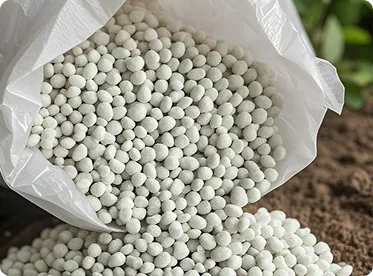
In a true complex NPK fertilizer, each granule is designed to carry a similar nutrient ratio. If you take one representative granule from a 15-15-15 complex fertilizer, it should contain nitrogen, phosphorus, and potassium in approximately the designed proportion.
FAO describes complex fertilizers as fertilizers produced through chemical reaction, with nutrients present together within the same granule.
You can explore this type of product through our NPK compound fertilizer range for commercial agriculture.
This is where fertilizer terminology becomes confusing.
Technically, compound fertilizer can be used as a broad category for fertilizers containing two or more primary nutrients. Under this definition, a compound fertilizer may be produced either through physical mixing or through chemical combination.
FAO states that fertilizer containing two or more primary nutrients can be called compound fertilizer. Such products may be made through chemical combination, creating complex fertilizers, or through physical mixing.
A simple classification looks like this:
| Fertilizer Type | Nutrients | Production Method | Nutrients in Each Granule |
|---|---|---|---|
| Straight fertilizer | Usually one primary nutrient | Single nutrient product | One main nutrient |
| Mixed fertilizer | Two or more | Physical mixing | May vary between granules |
| Complex fertilizer | Two or more | Chemical reaction/integrated granulation | Multiple nutrients in each granule |
| Compound fertilizer | Broad category | May include mixed or complex processes | Depends on manufacturing method |
However, commercial language is not always this strict.
In many fertilizer markets, manufacturers and buyers use compound fertilizer and complex fertilizer almost interchangeably to describe homogeneous granular NPK products.
That is why importers should never rely only on the product name.
Ask about:
Our detailed guide to straight fertilizer and complex fertilizer differences explains this terminology from another angle.
Mixed Fertilizer vs Compound Fertilizer: What Is the Difference Between Mixed and Complex Fertilizer?
The biggest difference between compound fertilizer and mixed fertilizer is how nutrients are combined and distributed.
Imagine two buckets.
In Bucket A, you put yellow urea granules, brown DAP granules, and white potassium fertilizer granules together. You mix them well.
That is a physical mixture.
In Bucket B, raw materials enter a production process involving reactions and granulation. The resulting individual granule contains nitrogen, phosphate, and potassium.
That is closer to a complex compound fertilizer.
| Feature | Mixed Fertilizer | Complex Fertilizer |
|---|---|---|
| Process | Physical mixing | Chemical/integrated production |
| Formula flexibility | Very high | High, but production is more complex |
| Nutrient distribution | Depends on mixing quality | More uniform within granules |
| Production cost | Often lower | Often higher |
| Granule composition | Different particles may carry different nutrients | Multiple nutrients in one granule |
| Segregation risk | Higher if particle sizes differ | Generally lower |
| Customization | Fast and flexible | Requires controlled production |
| Typical use | Regional/custom blends | Large-scale uniform nutrient programs |
These differences between compound and physically mixed fertilizer become especially important with mechanical spreading.
If granules differ greatly in size, density, or shape, physical mixtures can separate during transport and field application. Larger or heavier granules may travel differently from smaller ones.
That does not mean mixed fertilizer is poor fertilizer.
It means quality control matters.
For many buyers, a well-designed blended product offers excellent flexibility in nutrient ratios and can be very economical.
The manufacturing process is the heart of the difference.
Mixed fertilizer normally starts with finished fertilizer materials.
The manufacturer selects the required ingredients based on the target nutrient ratio. A formula might combine urea for nitrogen, DAP for N and P, and potassium chloride for K.
Typical stages include:
No major chemical reaction is needed.
The main challenge is achieving a stable mixture and preventing particle separation.
Our technical article on bulk blending fertilizer for modern agriculture explains how granule size, density, compatibility, and formulation affect BB fertilizer quality.
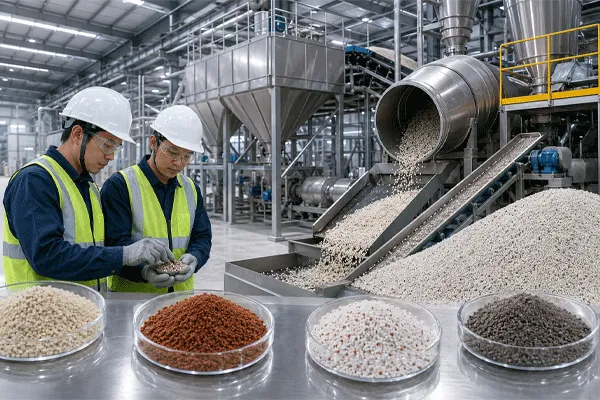
Complex fertilizer normally requires a more integrated production process.
Depending on the formula and factory, processes may include drum granulation, disc granulation, tower granulation, reaction granulation, drying, cooling, screening, coating, and packaging.
A simplified process may look like this:
Raw materials → Reaction/Mixing → Granulation → Drying → Cooling → Screening → Coating → Packaging
Some formulations use ammonia and phosphate materials during chemical reactions. Others combine nitrogen sources, phosphorus sources, and potassium compounds during granulation.
This complex manufacturing process requires closer control of temperature, moisture, reaction conditions, particle size, and nutrient content.
High tower granulation is another production route used for selected NPK formulas.
Different methods serve different goals. No single production method is automatically best for every fertilizer application.
This is one of the most important practical differences.
Consider a physical mixed fertilizer containing nitrogen, phosphorus, and potassium.
One granule may mainly be urea.
Another may be DAP.
Another may be potassium chloride.
The overall bag has the required nutrient content, but individual granules have different compositions.
With complex fertilizer, several nutrient elements can exist within each granule.
Mixed fertilizer
N | N+P | K | N | K | N+P
Different particles supply different nutrients.
Complex fertilizer
NPK | NPK | NPK | NPK | NPK
Each granule delivers a more similar nutrient profile.
This more uniform distribution of nutrients can be useful when fertilizer application rates are low or when growers need even field distribution.
However, high-quality mixed fertilizer can still provide very good results if:
Therefore, nutrient distribution is not simply “good versus bad.”
It is a question of production quality and application conditions.
Mixed Fertilizer vs Compound Fertilizer: What Is the Difference Between Mixed and Complex Fertilizer?
Both fertilizer types can offer many NPK ratios.
An NPK ratio expresses the guaranteed percentage of nitrogen, phosphate expressed as P₂O₅, and potash expressed as K₂O.
For example:
| Formula | Nitrogen | P₂O₅ | K₂O |
|---|---|---|---|
| 15-15-15 | 15% | 15% | 15% |
| 20-10-10 | 20% | 10% | 10% |
| 16-20-0 | 16% | 20% | 0% |
| 12-12-17 | 12% | 12% | 17% |
| 15-5-30 | 15% | 5% | 30% |
FAO notes that fertilizer grade is normally written in the order N-P₂O₅-K₂O. For example, a 12-32-16 grade indicates 12% nitrogen, 32% phosphate and 16% potash by weight.
What matters is matching the nutrient ratio to crop requirements.
Nitrogen supports vegetative development and chlorophyll formation.
Phosphorus supports energy transfer, root development, and reproductive growth.
Potassium supports water regulation, crop quality, stress tolerance, and many enzyme processes.
A grower should therefore choose fertilizer based on:
A 15-15-15 formula is not automatically a balanced fertilizer for every crop simply because all three numbers are equal.
Balanced nutrition means matching the fertilizer to the crop’s nutrient needs.
There is no universal winner.
The better fertilizer is the one that supplies the required plant nutrient elements at the right rate, location, and time.
For uniform broad-acre fertilizer application, a complex product can offer an advantage because each granule delivers several nutrients. This may improve consistency across the field.
Mixed fertilizer provides a different advantage: flexibility.
Suppose one region requires a ratio of nitrogen, phosphate, and potassium that is not widely sold as a standard compound product. A manufacturer may create a physical mixture much more quickly by adjusting the proportions of existing materials.
This can reduce unnecessary nutrient use.
A typical crop program might require:
The crop does not care whether the bag is called mixed, compound, or complex.
The crop responds to nutrient availability, soil conditions, timing, water, root health, and application accuracy.
A good fertilizer program therefore focuses on fertilizer efficiency and the actual needs of the plant.
Mixed fertilizer is especially useful where buyers need rapid formula customization.
1. High formulation flexibility
Manufacturers can adjust N, P and K levels by changing the proportions of different straight fertilizer materials.
2. Cost-efficient production
Because the materials are physically mixed, production may require less processing than traditional compound fertilizer.
3. Local nutrient targeting
A distributor can develop formulas for different soil types, crops, or regional fertilizer practices.
4. Fast OEM development
Private-label fertilizer companies may launch several formulas without building a completely new chemical production process for each grade.
Physical mixtures require good particle compatibility.
If urea, phosphate fertilizer, and potassium granules have very different particle sizes or densities, segregation can occur during transportation, unloading, or mechanical spreading.
Careful application therefore matters.
A high-quality mixed fertilizer should control:
For agricultural importers, asking for specification sheets and pre-shipment testing is wise.
The lowest price per ton does not always produce the lowest fertilization cost per hectare.
The main characteristics of complex fertilizers come from their integrated nutrient structure.
Because multiple nutrients can exist in the same granule, complex fertilizer can provide more uniform nutrient placement across a field.
Compound fertilizers offer several practical benefits:
They can also be suitable as a base fertilizer, depending on formula, crop, soil, and agronomic program.
A fertilizer containing nitrogen, phosphorus, and potassium may support strong plant growth when its nutrient balance matches the crop.
Still, complex fertilizer is not automatically the right fertilizer.
For example, if a soil already contains high potassium, adding a large amount of potassium and phosphorus through a fixed NPK compound could waste inputs.
Sometimes a straight fertilizer or customized mixed fertilizer is more economical.
This is why choosing the right fertilizer should begin with nutrient needs rather than product category.
For a small garden, the decision may involve one bag.
For a distributor importing hundreds of tons, the decision is much more serious.
We recommend evaluating fertilizer in several layers.
Ask:
Confirm:
Do not judge only by the total NPK number.
For granular fertilizer, examine:
Ask whether the product is:
A product for broadcasting does not have the same requirements as fertilizer for drip irrigation.
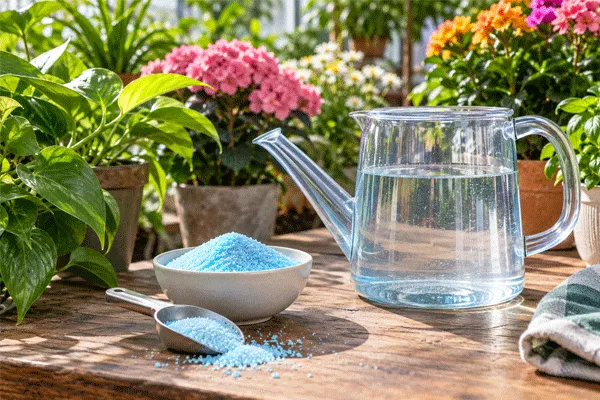
If fertigation is the goal, buyers should consider a fully water-soluble NPK fertilizer range for precision feeding rather than assuming that a granular compound product will dissolve cleanly.
This depends on your market position.
For fertilizer brand owners, mixed fertilizer offers excellent formula flexibility. You may be able to create several market-specific ratios using carefully selected straight and compound fertilizer materials.
For example, one distributor might sell:
A complex fertilizer may be more attractive when the market values uniform granules, consistent nutrient distribution, premium presentation, and mechanical spreading performance.
As a fertilizer manufacturer and exporter based in China, we normally look at the buyer’s target crop, local soil, required nutrient content, packaging, price range, application method, and import specifications before discussing the final formulation.
That approach is especially useful for:
A fertilizer should fit the market before the packaging is printed.
Imagine an importer serving both maize growers and fruit farms.
A single NPK product may not serve both markets well.
Maize production may emphasize nitrogen use during strong vegetative growth, while many fruit programs require a different balance of potassium and nitrogen at later stages.
Instead of asking:
“Which fertilizer is best?”
A better commercial question is:
“Which formula and manufacturing method best match each crop, application system, and selling price?”
That question usually leads to a better product portfolio.
Not exactly. Compound fertilizer is often used as a broad term for fertilizer containing two or more primary nutrients. Mixed fertilizer is one way to produce a multi-nutrient fertilizer, using physical mixtures of fertilizer materials.
In strict technical usage, complex fertilizer is produced through chemical reaction or an integrated manufacturing process so multiple nutrients occur within the same granule. Compound fertilizer can be used more broadly for fertilizers containing two or more primary nutrients. In commercial markets, the two terms are sometimes used interchangeably.
No. NPK tells you that the product supplies nitrogen, phosphorus, and potassium. It does not automatically tell you how the product was manufactured. An NPK fertilizer may be a physical blend or a complex granulated product.
Diammonium phosphate, or DAP, supplies nitrogen and phosphate and is a chemically produced NP fertilizer. It contains two primary nutrients and is commonly classified as a compound or complex fertilizer.
No. Urea is primarily a nitrogen fertilizer and contains one primary nutrient, nitrogen. In fertilizer classification, this makes urea a straight fertilizer, even though urea itself is a chemical compound.
Yes. Depending on the formulation and compatibility of materials, a mixed fertilizer may include micronutrient components. The manufacturer must control mixing carefully because small-dose micronutrients need uniform distribution.
The difference between mixed and complex fertilizer is easy to understand once you stop looking only at the numbers on the bag.
Mixed fertilizer combines separate fertilizer materials physically. Complex fertilizer integrates multiple nutrients through chemical reaction or controlled granulation.
Both can be valuable.
Both can support crop yield.
And both can fail if the nutrient ratio, application rate, soil condition, or crop stage is wrong.
For agricultural distributors and OEM fertilizer brands, mixed products may offer faster customization and price flexibility. For commercial farms and projects requiring consistent granule-level nutrient distribution, complex fertilizer may offer important advantages.
As a professional China-based fertilizer manufacturer and exporter, our role is not simply to supply fertilizer by tonnage. We help buyers evaluate crop requirements, NPK ratios, fertilizer form, raw materials, granulation method, micronutrients, packaging, and OEM specifications so the finished product matches the intended agricultural market.