Avoid your inquiry is delay response, please enter your WhatsApp/Skype along with the message, so we can contact you at the very first time.
We will reply you within 24 hours. If for urgent case, please add WhatsApp/WeChat: ,. Or call directly.
Mixing the wrong fertilizer can turn a clear nutrient solution into cloudy sludge, block irrigation lines, waste valuable nutrients, and stress plants. The good news is simple: once you understand fertilizer compatibility, nitrate, phosphate, calcium, and sulfate fertilizers become much easier to manage safely.
Many fertilizers can be mixed together, but compatibility depends on their chemical form, concentration, water quality, and application method. Nitrate fertilizers often mix well with other nitrates, while calcium fertilizers should generally be kept out of concentrated solutions containing phosphate or sulfate. For fertigation, use separate A/B stock tanks and perform a jar test before making unfamiliar fertilizer combinations.
As a leading fertilizer manufacturer and exporter based in China, we regularly work with agricultural distributors, commercial farms, cooperatives, government agricultural projects, and fertilizer brand owners. One lesson matters across all these markets: a good fertilizer formula is not only about nutrient percentages. The nutrients must also remain usable when they reach the crop.
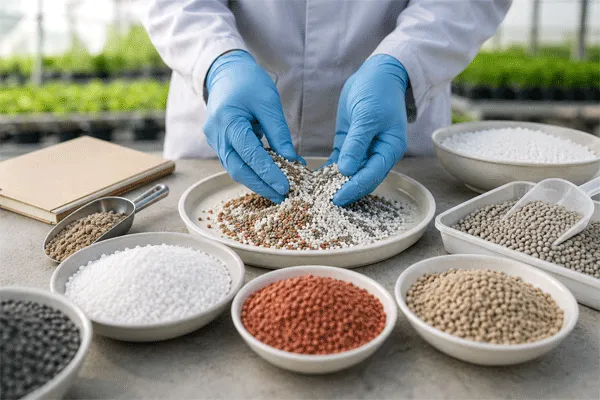
Which Fertilizers Can Be Mixed Together? Fertilizer Mixing, Nitrate, Phosphate & Compatibility Guide
Fertilizer compatibility describes whether two or more fertilizer materials can stay physically and chemically stable when they are combined. This is especially important with water-soluble fertilizer and fertigation, where dissolved nutrients must move through injectors, filters, pipes, and drip emitters.
Two fertilizers may each dissolve perfectly on their own but become incompatible when combined. For example, dissolved calcium may react with phosphate or sulfate. The result can be an insoluble solid such as calcium phosphate or calcium sulfate. That solid is no longer moving freely in solution and may become less available to plants.
Clemson University notes that fertilizer materials can react with each other or with minerals already present in irrigation water, producing precipitates that reduce nutrient delivery and may clog micro-irrigation equipment. This is why understanding compatibility is part of good nutrient management, not merely a mixing convenience.
For buyers looking for ready-made nutrient ratios rather than field mixing individual salts, our NPK compound fertilizer range offers balanced and customized formulations for different crops and markets.
There is no universal rule saying that all nitrogen, phosphorus, or potassium products are automatically compatible. You need to look at the complete fertilizer source.
In concentrated water-soluble fertilizer stock solutions, combinations such as potassium nitrate with many phosphate fertilizers are commonly easier to manage than combinations containing calcium. Nitrate itself is usually not the main compatibility problem. The calcium ion is often the issue when calcium meets concentrated phosphate or sulfate.
Here is a practical compatibility chart for common fertigation materials:
| Fertilizer Combination | General Stock-Tank Guidance | Main Concern |
|---|---|---|
| Potassium nitrate + potassium phosphate | Usually compatible | Watch total salt concentration |
| Potassium nitrate + urea | Often compatible | Solubility and EC |
| Urea + many soluble NPK fertilizers | Often compatible | Check formulation |
| Calcium nitrate + potassium nitrate | Generally compatible | Concentration |
| Calcium nitrate + phosphate | Do not combine in concentrated stock | Calcium phosphate precipitation |
| Calcium nitrate + magnesium sulfate | Do not combine in concentrated stock | Calcium sulfate precipitation |
| Calcium nitrate + potassium sulfate | Do not combine in concentrated stock | Calcium sulfate formation |
| Magnesium sulfate + many non-calcium fertilizers | Often compatible | pH and concentration |
| Micronutrient products + phosphate | Check first | Some metals may precipitate |
| Unknown products | Jar test first | Unpredicted chemical reactions |
These are working compatibility rules, not substitutes for the product label, Safety Data Sheet, water analysis, or supplier recommendation. Concentration makes a major difference. Two nutrients that eventually enter the same irrigation line at high dilution may still need separate concentrated stock tanks.
For precision irrigation programs, buyers can also review our water-soluble NPK fertilizer solutions, including customizable ratios for different growth stages and crop requirements.
The most important rule in safe fertilizer mixing is:
Do not put concentrated calcium fertilizer together with concentrated phosphate or sulfate fertilizer unless the manufacturer has specifically confirmed compatibility.
A classic example is calcium nitrate with phosphate fertilizer. Mixing calcium nitrate with a strong phosphate source may form calcium phosphate. Likewise, mixing calcium with magnesium sulfate, potassium sulfate, or another strong sulfate source can cause the precipitation of calcium as calcium sulfate.
University of Kentucky and North Carolina State University authors highlight calcium nitrate plus magnesium sulfate as a common stock-solution incompatibility. UC Agriculture and Natural Resources gives calcium nitrate plus potassium sulfate as another example of a mixture that can produce gypsum and clog irrigation equipment.
This does not mean plants cannot receive calcium, phosphorus, magnesium, sulfur, and nitrogen in the same nutrition program. They certainly can. It means we must manage how and where those nutrients meet.
Calcium nitrate is useful because it supplies readily available calcium and nitrate nitrogen. Phosphate fertilizers supply phosphorus, which plants need for root development, energy transfer, flowering, and many other processes.
The trouble begins when high levels of dissolved calcium and phosphate meet in a concentrated fertilizer tank. Their ions can form poorly soluble calcium phosphate compounds.
In simple terms:
Dissolved calcium + concentrated phosphate → possible solid precipitate
That creates several problems:
The same principle explains why professional fertigation systems often place calcium nitrate in Tank A, while phosphate and sulfate sources stay in Tank B. They only meet after injection and strong dilution.
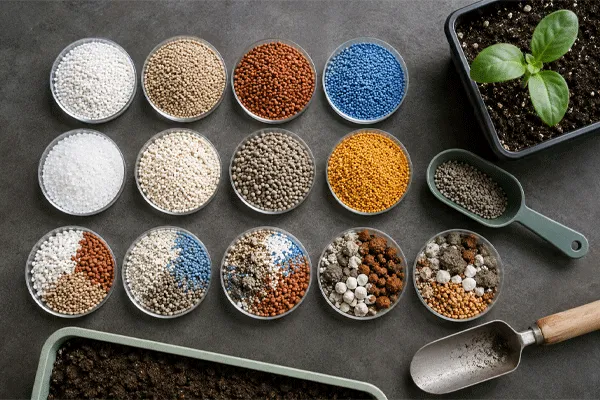
Which Fertilizers Can Be Mixed Together? Fertilizer Mixing, Nitrate, Phosphate & Compatibility Guide
Sulfate is an important sulfur source. Products such as ammonium sulfate, potassium sulfate, and magnesium sulfate can help supply sulfur along with nitrogen, potassium, or magnesium.
However, sulfate deserves special attention when calcium is present. Calcium and sulfate can form calcium sulfate, commonly associated with gypsum precipitation. That is why calcium and magnesium programs often use different fertilizer salts in concentrated stock systems instead of simply putting calcium nitrate and magnesium sulfate into the same container.
This does not make sulfate a “bad” nutrient. Far from it. It simply needs correct handling. Our ammonium sulphate fertilizer is designed as a nitrogen and sulfur fertilizer source for agricultural applications, while its use in fertilizer combinations should still follow proper compatibility and application guidance.
Good mixing practices protect both nutrient efficiency and irrigation equipment.
Fertigation sends soluble fertilizer through irrigation water. It can help feed plants more precisely, especially when the fertilizer rate changes across different crop growth stages.
For many commercial systems, the safest approach is an A/B tank system.
Tank A
Tank B
Then the two fertilizer streams enter the irrigation system separately and become highly diluted before meeting.
Tank A: Calcium + Nitrate
             \
              > Dilution in irrigation line > Crop root zone
             /
Tank B: Phosphate + Sulfate + Potassium
This approach helps improve nutrient efficiency, reduces precipitation risk, and protects emitters from deposits. Haifa’s fertigation guidance similarly explains that calcium-based products are normally separated from concentrated phosphate and sulfate solutions.
Cold conditions also matter because cold water reduces solubility for many fertilizer salts. A fertilizer source that dissolves well under one set of conditions may leave crystals when temperature falls or the stock solution becomes too concentrated.
A jar test is one of the simplest ways to identify a possible compatibility problem before you fill a large tank.
The University of Kentucky/e-GRO guide recommends using a small sample made with the actual water and planned fertilizer concentration, then allowing it to stand and checking for cloudiness, solids, or precipitation.
If the solution turns cloudy or develops solids, avoid mixing the products in the main system until the cause is identified.
A jar test is especially useful when:
Do not assume that two products with similar labels behave identically. Raw material quality, impurities, concentration, pH, and formulation can all affect performance.
Yes. Sometimes the fertilizer combination is not the only problem. The water itself already contains minerals.
Natural water can contain calcium and magnesium, bicarbonate, sulfate, sodium, and other dissolved salts. If water has high calcium or magnesium levels, adding phosphate fertilizer can increase the chance of precipitation. Clemson Extension notes that phosphate fertilizers are particularly sensitive when irrigation water contains high dissolved calcium and magnesium, especially under more alkaline conditions.
Important water factors include:
This is also why soil pH and water pH should not be treated as the same thing. The soil affects nutrient behavior in the root zone, while irrigation water chemistry affects what happens before the nutrients even reach the field.
For large farms, distributors supplying fertigation products, and government agricultural projects, water testing can prevent expensive compatibility issues before a full fertilizer program begins.
No. This distinction is very important.
When people ask, “Can I mix fertilizers?”, they may mean one of three completely different jobs:
Mixing soluble fertilizer concentrates for fertigation.
Combining already diluted liquid fertilizer solutions.
Dry blending granular fertilizers.
Each situation has different risks.
A professionally produced compound or NPK fertilizer is manufactured under controlled conditions. A dry bulk blend combines selected compatible granules with attention to particle size, moisture behavior, nutrient analysis, storage stability, and segregation.
That is different from randomly combining bags on a farm.
For example, ammonium nitrate is a useful nitrogen fertilizer but also a strong oxidizer. Its storage and blending require additional safety controls. The U.S. EPA warns that ammonium nitrate must be protected from contamination with combustible or incompatible materials and recommends using product safety information when assessing fertilizer blends.
Therefore, do not treat ammonium nitrate fertilizer blending as a casual DIY task. Commercial blends should come from qualified fertilizer manufacturers following appropriate safety, quality, and local regulatory requirements.
Buyers who need controlled, ready-to-market formulations can explore our custom NPK mixed fertilizer options.

Which Fertilizers Can Be Mixed Together? Fertilizer Mixing, Nitrate, Phosphate & Compatibility Guide
For a small grower, one failed fertilizer tank is frustrating. For an importer, cooperative, national agricultural project, or private-label brand, one unsuitable formulation can become a much larger commercial problem.
That is why we recommend looking beyond the NPK number when sourcing a custom fertilizer.
Evaluate:
For example, an NPK formula designed for granular soil application does not automatically make the best soluble fertilizer for drip fertigation. Likewise, a high-phosphorus soluble formula may need to stay separate from concentrated calcium fertilizer.
As a China-based manufacturer and exporter, we support agricultural distributors and importers, commercial farms and cooperatives, government and NGO agricultural projects, and fertilizer brand owners looking for crop-specific or regional formulas. Our OEM fertilizer manufacturing service supports customized ingredients, product presentation, and packaging for different markets.
The goal is not simply to sell more fertilizer. It is to help buyers select products that feed plants efficiently, fit local application systems, and reduce avoidable compatibility problems. You can also learn more about our fertilizer manufacturing and product capabilities on the Lvfeng Fertilizer company website.
Consider a commercial vegetable farm that needs nitrogen, calcium, phosphorus, potassium, magnesium, and sulfur through drip irrigation.
The farm could use:
Putting everything into one concentrated tank looks convenient. It may even save time and labor at first.
But calcium can react with both phosphate and sulfate. The result may be cloudiness, precipitation, lower nutrient availability, and clogged emitters.
A better system separates the calcium source from the phosphates and sulfates, then injects both solutions into the irrigation stream at controlled dilution.
The plants still receive all the nutrients they need. The chemistry is simply managed more intelligently.
That is what understanding compatibility means in modern agriculture: not using fewer nutrients, but delivering them in a form the system and crop can actually use.
They are generally considered compatible in many fertilizer stock programs because both are nitrate-based salts. However, concentration, temperature, product purity, and water chemistry still matter. Perform a jar test when using an unfamiliar combination or concentration.
They should generally never mix in the same concentrated stock solution because calcium may react with phosphate and form insoluble calcium phosphate. Use separate stock tanks where appropriate.
Avoid combining them in a concentrated fertilizer stock tank. Calcium and sulfate can form calcium sulfate precipitate, potentially reducing nutrient availability and clogging irrigation equipment.
Ammonium sulfate can be used in many fertilizer programs and commercial blends, but compatibility depends on the other fertilizer source and application method. In concentrated fertigation solutions, keep sulfate products separate from calcium-rich products unless compatibility has been confirmed.
Urea can be part of many NPK and chemical fertilizer programs. However, whether two specific products should be mixed depends on formulation, moisture, physical compatibility, storage time, and whether the materials are being dry blended or dissolved. Follow supplier recommendations rather than assuming all nitrogen fertilizers behave alike.
Cloudiness often means something has precipitated or failed to dissolve. Possible causes include incompatible fertilizer salts, excessive concentration, unsuitable pH, hard water, or low water temperature. Stop before using the mixture and investigate the cause instead of sending solids into an irrigation system.