Avoid your inquiry is delay response, please enter your WhatsApp/Skype along with the message, so we can contact you at the very first time.
We will reply you within 24 hours. If for urgent case, please add WhatsApp/WeChat: ,. Or call directly.
A compound and a mixture can look almost identical, yet they behave very differently. Confusing them can lead to wrong answers in chemistry and wrong assumptions about products such as fertilizers. The good news is simple: check composition, bonding, properties, and how the material can be separated.
The main difference between compound and mixture is that a compound contains two or more elements chemically bonded in a fixed ratio, while a mixture contains two or more substances physically combined in variable proportions. A compound forms a new substance and requires chemical change to separate its elements. A mixture keeps the identities of its components and can usually be separated by physical methods.
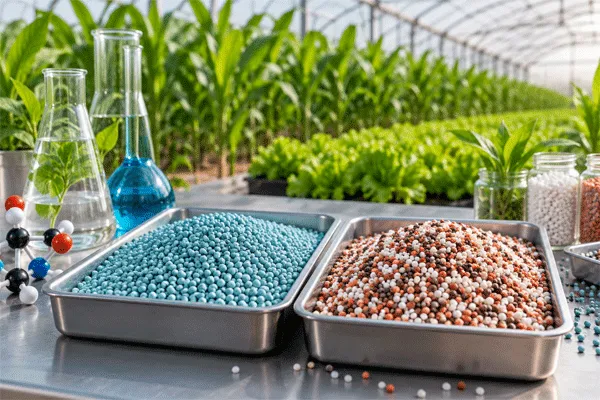
How to Tell the Difference Between a Compound and Mixture: Compound vs Mixture Guide
A compound is a pure substance made from two or more different elements that are chemically combined in a definite proportion. The atoms are chemically bonded together, so the resulting material has its own identity and properties.
Water is a simple example. Hydrogen and oxygen can combine to form H₂O. Every pure water molecule contains two hydrogen atoms for each oxygen atom. You cannot change this ratio and still call the substance water.
Another common example is sodium chloride, NaCl. Sodium is a reactive metal, while chlorine is a gas under normal conditions. When the elements react, however, they form sodium chloride, a white crystalline compound with very different properties.
OpenStax explains that pure substances have constant composition, while a compound consists of two or more types of atoms and can be broken down through chemical change.
A compound normally has these characteristics:
For example:
| Compound | Formula | Elements Present |
|---|---|---|
| Water | H₂O | Hydrogen, oxygen |
| Sodium chloride | NaCl | Sodium, chlorine |
| Carbon dioxide | CO₂ | Carbon, oxygen |
| Ammonia | NH₃ | Nitrogen, hydrogen |
| Urea | CH₄N₂O | Carbon, hydrogen, nitrogen, oxygen |
The chemical formula helps indicate the elements present and their relative proportions. The composition of compounds is therefore much more exact than the composition of most mixtures.
A mixture is formed when two or more substances are physically combined without becoming a completely new chemical substance.
The components of a mixture may be elements, compounds, or both.
Saltwater is an easy example. Water and sodium chloride form a homogeneous mixture when salt dissolves. The salt does not suddenly become a different chemical element. The water also remains water.
Likewise, a mixture of sand and water contains two materials that remain chemically recognizable.
According to OpenStax, a mixture contains two or more forms of matter that may be present in varying amounts and can be separated through physical changes.
A mixture is a combination rather than a single pure substance. This means the amount of each constituent can change.
For example:
Mixture A:
30% Material X + 70% Material Y

Mixture B:
50% Material X + 50% Material Y

Mixture C:
70% Material X + 30% Material Y
All three may still be mixtures of the same two components.
A compound does not work like this. If the atomic ratio changes, you may create a different compound or simply have a mixture of substances.
Common examples of mixtures include:
Air, for example, is a mixture of gases containing mainly nitrogen and oxygen along with argon, carbon dioxide, water vapor, and smaller amounts of other gases.
The easiest way to understand compound vs mixture is to compare their structure directly.
| Feature | Compound | Mixture |
|---|---|---|
| Composition | Fixed | Variable |
| Formation | Chemical bonding/reaction | Physical mixing |
| Components | Two or more elements | Two or more substances |
| Ratio | Fixed ratio | Can vary |
| New substance formed? | Yes | Usually no |
| Components keep original properties? | Usually no | Generally yes |
| Separation | Chemical methods | Physical methods |
| Chemical formula | Yes | No single formula |
| Pure substance? | Yes, if pure | No |
| Examples | H₂O, NaCl, CO₂ | Air, saltwater, soil |
These are the key differences to remember.
A compound is a pure substance when it contains only that chemical material. Its composition does not change from one pure sample to another.
A mixture, however, can vary.
For example, one saltwater sample may contain 2% salt while another contains 5%. Both remain saltwater mixtures.
LibreTexts similarly explains that a pure compound has constant composition, while a mixture contains physically combined components whose proportions can change.
Think of it this way:
Compound = chemical bond + fixed ratio.
Mixture = physical combination + variable ratio.
That one rule solves many basic chemistry questions.
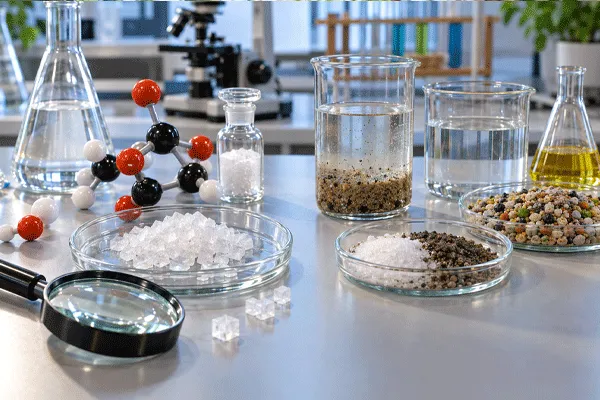
How to Tell the Difference Between a Compound and Mixture: Compound vs Mixture Guide
To understand compounds and mixtures, first understand an atom.
An atom is a basic unit of an element. Each chemical element has a specific atomic number, which identifies the number of protons in its nucleus.
The periodic table organizes these elements.
Hydrogen, nitrogen, phosphorus, potassium, oxygen, sulfur, zinc, iron, and carbon are examples of different elements found on the periodic table.
An element contains only one type of atom in chemical terms. For example, elemental iron contains iron atoms. Elemental oxygen consists of oxygen atoms, even though normal oxygen gas commonly exists as O₂ molecules.
The differences between elements and compounds are also important.
An element cannot be chemically broken into a simpler chemical substance. A compound can.
For example:
Element:
Fe = Iron

Compound:
NaCl = Sodium + Chlorine chemically bonded

Mixture:
NaCl + H₂O = Saltwater
A compound is made up of two or more different types of atoms that are chemically bonded in a defined arrangement or ratio.
That chemical bonding creates properties that may be very different from those of the constituent elements.
This is one reason the chemistry of fertilizer production matters. Nitrogen, phosphorus, potassium, sulfur, magnesium, iron, zinc, and other nutrients can exist in many different chemical forms, and plants may respond differently to those forms.
For buyers who want to understand common agricultural nutrient combinations, our guide on how to choose the right NPK fertilizer ratio explains how N, P, and K proportions change according to crop needs.
Another good way to identify an unknown material is to ask:
Can its components be separated without changing their chemical identities?
If yes, you are probably dealing with a mixture.
Mixtures can be separated through differences in physical properties.
Common methods include:
For example, filtration can separate sand from water because sand particles do not dissolve in the water.
Evaporation can remove water from some salt solutions and leave solid material behind.
Distillation can separate certain liquids based mainly on differences in volatility and boiling behavior. OpenStax describes distillation as a widely used method that selectively vaporizes and condenses components of a mixture.
So, mixtures can often be separated through physical methods because their components have not necessarily reacted to form one new chemical substance.
A compound is different.
You cannot separate pure water into hydrogen and oxygen with simple filtration. Both elements are chemically bonded.
Breaking a compound apart generally requires a chemical reaction, electrolysis, decomposition, or another chemical process.
This is a useful test:
Physical separation possible?
        ↓
      Yes
        ↓
Likely a mixture

Chemical change required?
        ↓
      Yes
        ↓
Likely a compound
The word “separated” needs some care, though. Compounds can be separated into simpler chemical substances only through chemical change; they cannot normally be separated into their constituent elements by ordinary physical means.
Not every mixture looks mixed.
This is where homogeneous mixtures and heterogeneous mixtures become important.
A homogeneous mixture appears uniform throughout the sample.
Its different parts are not easy to distinguish with the naked eye.
Examples include:
If you take small samples from different parts of a well-prepared homogeneous solution, they should have essentially the same composition at that scale.
OpenStax notes that solutions are homogeneous and that their components are distributed at the molecular or ionic level.
However, a homogeneous mixture is still a mixture. Uniform appearance does not turn it into a compound.
A heterogeneous mixture is not uniform throughout.
Different components or phases may be visible.
Examples include:
The different parts of the mixture may contain different concentrations of each constituent.
That distinction becomes important in fertilizer quality control.
If a bulk fertilizer blend contains particles with very different sizes, densities, or shapes, segregation can occur during transportation and handling. One section of the bag may no longer have exactly the same nutrient distribution as another.
For commercial buyers, physical uniformity therefore matters even when the guaranteed nutrient analysis looks correct on paper.
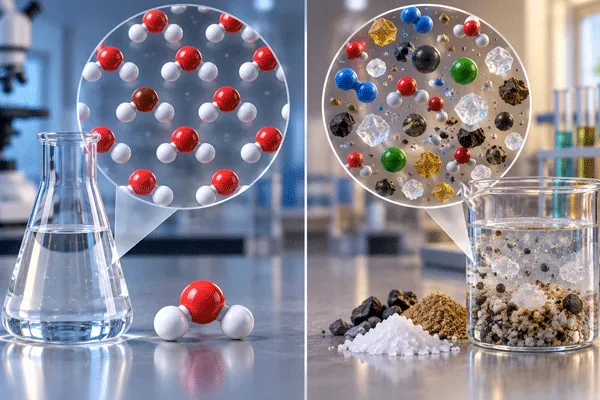
How to Tell the Difference Between a Compound and Mixture: Compound vs Mixture Guide
Every material has physical and chemical properties.
Physical properties can be observed without changing the chemical identity of the substance.
Examples include:
Chemical properties describe how a substance reacts or changes chemically.
Examples include:
The properties of compounds are often very different from those of the elements that make them.
Again, sodium chloride is the classic example.
Sodium metal and chlorine gas have very different properties from table salt. Once their atoms are chemically combined, a new substance forms.
Pure compounds also tend to have characteristic physical properties under specified conditions, including defined melting and boiling behavior.
The properties of a mixture depend on:
Because mixtures can have variable composition, properties such as density, color, concentration, and boiling behavior can also vary.
That gives us another useful rule:
If changing the proportion of ingredients still produces the same general material category, it is usually a mixture rather than one pure compound.
This is especially important for agricultural buyers.
In basic chemistry, a compound means a pure substance with elements chemically bonded in a fixed composition.
But in the fertilizer industry, compound fertilizer is a commercial product classification.
These meanings overlap in language, but they are not identical.
For example, urea is a chemical compound. Potassium chloride is a chemical compound. Monoammonium phosphate is also a defined chemical compound.
However, a finished NPK fertilizer may contain several nutrient-bearing chemical substances.
An industrial NPK compound fertilizer can be produced through processes such as reaction, granulation, slurry processing, or integrated granulation so that multiple nutrients are distributed within the fertilizer granule.
That finished fertilizer should not automatically be described as one single pure chemical compound.
This distinction matters.
As a leading manufacturer and exporter of high-quality fertilizer products based in China, we often work with agricultural distributors, commercial farms, government projects, and OEM fertilizer brands. In professional discussions, we therefore separate chemical terminology from fertilizer product terminology.
Our NPK compound fertilizer range includes multiple nutrient ratios developed for different crops, soils, and regional requirements.
Imagine an NPK 15-15-15 fertilizer.
The label tells you the guaranteed nutrient analysis. It does not tell you that the entire bag consists of one molecule called “NPK 15-15-15.”
It does not.
Instead, the finished fertilizer may contain several nutrient compounds and supporting materials manufactured into a controlled fertilizer product.
That is a critical difference between textbook chemistry and commercial fertilizer terminology.
The distinction becomes even more useful when comparing compound fertilizer with blended fertilizer, often called BB fertilizer or bulk blend fertilizer.
In fertilizer manufacturing, compound fertilizer commonly uses manufacturing processes designed to combine nutrient materials into granules with controlled NPK composition.
Potential advantages include:
Buyers can view our custom NPK compound fertilizer formulas for examples of balanced, high-nitrogen, high-phosphorus, and high-potassium grades.
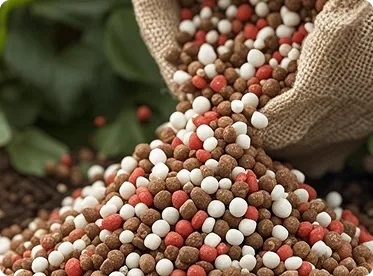
A bulk blended fertilizer is more clearly a physical mixture of compatible fertilizer granules.
Typical components may include nutrient sources supplying nitrogen, phosphorus, potassium, sulfur, or micronutrients.
Our NPK blending fertilizer and BB fertilizer range is designed for buyers who need flexible nutrient ratios, bulk supply, and customized regional formulas.
A simplified comparison looks like this:
| Factor | Compound Fertilizer | Bulk Blended Fertilizer |
|---|---|---|
| Production principle | Integrated processing/granulation | Physical blending |
| Nutrient distribution | Multiple nutrients may occur within granules | Nutrients often come from separate granules |
| Formula flexibility | High | Very high |
| Segregation risk | Generally lower with uniform granules | Must be controlled carefully |
| OEM potential | High | High |
| Common use | Broad commercial agriculture | Regional/crop-specific bulk programs |
This distinction matters for distributors and large farms.
Two products may have the same declared NPK ratio yet behave differently during transportation, spreading, dissolution, storage, and application.
A commercial water-soluble fertilizer may contain several chemical compounds formulated together.
Before dissolution, it can therefore be a formulated mixture of nutrient compounds.
After it dissolves, the fertilizer solution becomes a homogeneous mixture containing dissolved ions and molecules distributed throughout the water.
That makes water-soluble fertilizer an excellent real-life example of why we must distinguish a chemical compound from a commercial formulation.
Our water-soluble NPK fertilizer range includes balanced and crop-specific formulas designed for fertigation, drip irrigation, greenhouse production, and other precision feeding systems.
For example, NPK 20-20-20+TE water-soluble fertilizer supplies nitrogen, phosphorus, potassium, and trace elements in a soluble agricultural formulation.
Again, “20-20-20” describes nutrient analysis. It is not a molecular chemical formula.
That small distinction prevents a big misunderstanding.
When you need to classify an unfamiliar substance, use this five-step test.
If every pure sample must contain the same elements in exactly the same chemical proportions, you may have a compound.
If the proportion can change, you probably have a mixture.
If different elements are chemically bonded together, a compound may have formed.
If materials are only physically combined, you have a mixture.
A chemical reaction may produce a new substance with properties different from the original materials.
Simple mixing normally does not.
If mixtures can be separated through filtration, distillation, screening, evaporation, or other physical methods, that points toward a mixture.
If separation requires breaking chemical bonds, it points toward a compound.
Compounds are represented by formulas such as:
A mixture has no single molecular formula describing all of its components.
                MATERIAL
                   │
         ┌─────────┴─────────┐
         │                   │
   Fixed composition?      Variable?
         │                   │
        YES                  YES
         │                   │
   PURE SUBSTANCE          MIXTURE
         │
   ┌─────┴─────┐
   │           │
One element?  Multiple elements
   │           chemically bonded?
   │             │
ELEMENT       COMPOUND
This method works well for both classroom chemistry and basic industrial material discussions.
For a small chemistry test, identifying compounds and mixtures may earn you a correct answer.
For a commercial fertilizer buyer, understanding material composition can influence a container-sized purchasing decision.
Agricultural distributors and importers should consider questions such as:
For projects seeking both mineral and organic inputs, buyers can also compare our organic-inorganic compound fertilizer solutions.
Consider a distributor purchasing fertilizer for maize, vegetables, and fruit farms.
The company may request one NPK analysis, but the correct product format still depends on how customers will use it.
A mechanized broad-acre farm may prioritize uniform granules and spreading performance. A regional distributor may need flexible BB formulas. A greenhouse project may require a fully soluble product for fertigation.
Same agricultural goal. Different material design.
This is where manufacturing knowledge matters.
As a China-based fertilizer manufacturer and exporter, we support Agricultural Distributors & Importers, Commercial Farm Owners & Cooperatives, Government & NGO Agricultural Projects, and Fertilizer Brand Owners with formula selection, bulk supply, and OEM/private-label options.
For professional buyers, the better question is not simply:
“Is this fertilizer a compound or mixture?”
It is:
“How is the fertilizer manufactured, what chemical nutrient sources does it contain, and is that structure suitable for my market and application method?”
That question leads to better procurement decisions.
Yes. In chemistry, a compound is a pure substance when the sample contains only that compound. It has a definite chemical composition and characteristic properties.
For example, pure sodium chloride always follows the defined NaCl composition.
A manufactured mixture may be produced to a very precise target recipe, but its components are still physically combined rather than converted into one single pure chemical compound.
The important distinction is chemical identity, not simply manufacturing accuracy.
No.
This is a common mistake.
A homogeneous material may be a pure substance or a homogeneous mixture. Saltwater can look completely uniform, yet it remains a mixture of water and dissolved salt.
No, not into their chemically bonded constituent elements.
Filtration separates materials based on physical differences such as particle size or phase. Breaking the chemical bonding inside a compound requires a chemical process.
Remember two words:
Fixed versus variable.
A compound contains constituent elements in a fixed chemical ratio. A mixture can contain its components in variable proportions.
Then check bonding: a compound involves chemical bonding; a mixture generally involves physical combination.
Usually, no.
“NPK compound fertilizer” is an agricultural product category, not the name of one molecule. The finished fertilizer can contain multiple nutrient-bearing compounds processed into a multi-nutrient fertilizer product.
This is why fertilizer industry terminology should not be confused with the strict chemistry definition of a compound.
The difference between compound and mixture becomes much easier when you focus on composition and bonding.
A compound is formed when two or more elements chemically combine in defined proportions. The elements are bonded and form a substance with its own characteristics.
A mixture is formed when two or more substances come together physically. Its composition may vary, and the individual substances normally retain their chemical identities.
For fertilizer buyers, there is one extra lesson to remember: compound fertilizer is an industry term and should not be treated as meaning one pure chemical compound.
Understanding that distinction can help importers, distributors, farm cooperatives, NGO projects, and OEM fertilizer brands compare products more accurately.